Blood Hook (1986)

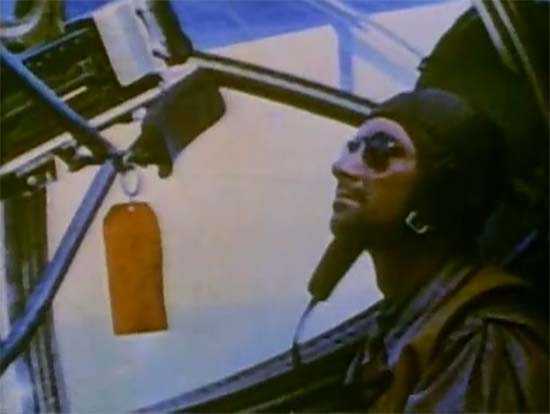
Wisconsin, America’s Dairyland, is home to homemade landing pads for UFOs, multiple haunted houses, a snaggle-toothed monster called the “Hodag,” mysterious Indian burial mounds, the magical House on the Rock (where, according to Neil Gaiman, the forgotten gods of the world assemble), serial killers Ed Gein and Jeffrey Dahmer, and, of course, some fine, fine fishin’. So it’s appropriate that the state has its share of locally-brewed horror films, from Bill Rebane’s The Giant Spider Invasion to the evil-teddy-bear opus The Pit. However, it took one James Mallon, Mystery Science Theater 3000 co-creator and the UW graduate who relocated the Statue of Liberty to Madison’s Lake Mendota, to create a Wisconsin horror film specifically centered on the wonders of fishing.  Muskie fishing.
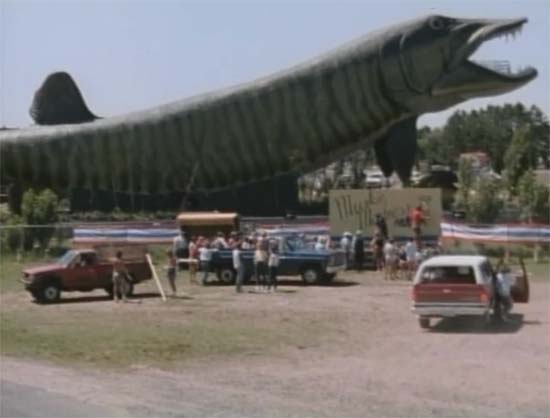
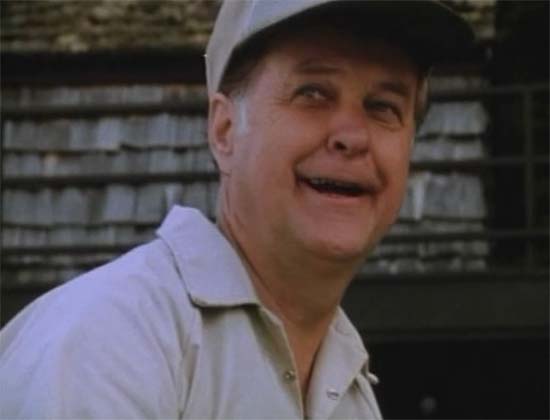
1986’s Blood Hook begins with two groups of Illinois tourists traveling north to Wisconsin to attend Muskie Madness, which, in this film, has all the import of Woodstock.  One is a suburban family from Oak Park; upon greeting the owner of Luedke’s Live Bait, the father offers a cheery hello: “What the hell is this supposed to be?  Say, we’re looking for the CAMPGROUND.”  Leroy Luedke, proprietor, answers in the indecipherable Wisconsinite language, “Well, that’s around the lake there.  It’s about four miles now, yah.” The father responds, “Can’t you people put some signs up? I mean, that’s what tax money is all about, I mean why don’t you put up some good signs for crying out loud?”  The slowburning regional tensions are gently diffused when Luedke offers the young son a stud finder for free.  (“Merry Christmas!”)  As will later be revealed, this is a key plot element.  Before the bait salesman sends the outsiders away, he provides a somber word of warning, you betcha: “Remember, the lake’s not a playground.  We have to treat the water with respect.”

Amongst our second group of tourists, five young twentysomethings, is a lad named Peter Van Cleese, whose grandfather died in a mysterious accident in Wisconsin seventeen years ago; they’re going to stay at his grandfather’s cabin.  Peter is a music enthusiast, playing tapes of his favorite rock bands (actually just a song by a band called “Red Elbows,” replayed ad infinitum throughout the film), to the disinterest of his friends.  As they approach Muskie Madness, New-Waver Rodney opines from the backseat, “This like hippie music makes me feel like I’m like full of chowder man, I mean like how long do I have to suffer, huh?” But Rodney, getting into the spirit of things, wears a giant fishing lure as an earring.  This is foreshadowing of his evil fate.  Of the other passengers: Finner is an expert fisherman; valley-girl Kiersten thinks fishing is “Rude!”; and Ann, who practices meditation, is interested in Peter, but he’s too distracted by thoughts of music, and haunted by memories of his grandfather’s death, to think about sex.  (Blood Hook opens with the death scene…and witnessing an old man describe how a tape recorder works before suddenly grabbing his ears, making a scream, and falling directly forward into the water is very haunting.)

Once they arrive at Muskie Madness, Finner’s skills are put to the test, as he challenges local celebrity Denny Dobyns to a cast-off.  The secret to Finner’s success: tassels.

They also meet Bev, a single mom and exercise enthusiast, who has the hots for Finner, and Evelyn Duerst (male), a shaggy-bearded, M16-toting conspiracy theorist. Evelyn’s father, Wayne Duerst, looks like Red Green, stands stock still and shouts phrases such as “You’re all crazy!” and “The whole world’s gone crazy!” and (directed to a boom box) “Turn off that goddamn headache machine!” Perhaps Wayne is so riled up because he’s caught his rival, Denny, force-feeding his own 40-pound muskie so that he can later “catch” it and win the Muskie Madness competition. Instead, Wayne steals it and dumps it in the lake, later to be caught…by Finner. How will Denny respond? With rage, with madness…with murder?

That night, the family from Illinois has a heated discussion about who stars in On Golden Pond, and the wonders of loons. It’s all building up toward a devastating tragedy.

The loon-obsessed matriarch of this family, storming out of the restaurant and down to the lake after her loon calls go unappreciated by her brood, is suddenly snagged by a hook–a blood hook–and spun about before being yanked straight off the pier. Immediately the viewer is left with a series of troubling questions. Is the hook self-animated, possessed by a demon, or perhaps the spirit of a muskie fisherman long dead? Was the fatal line cast by one of the many suspicious locals? One of the crazy Duerst clan? Or expert caster Denny Dobyns? Or that Leroy Luedke, yah? Or perhaps her own son, further infuriated that she cannot tell the difference between Peter and Henry Fonda?
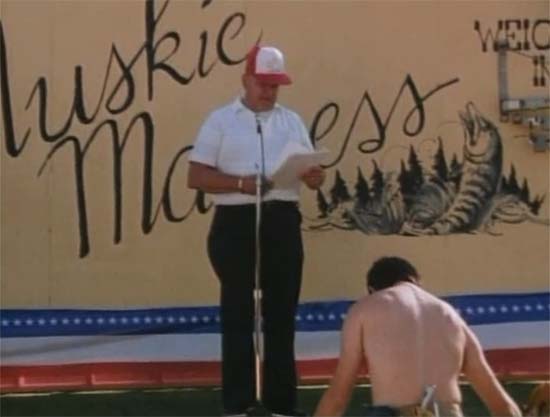
But the dreadful occurrences do not stop there. Granted, it takes a while, but the hook does strike again. After a failed attempt on the life of Bev’s young child (tastefully, the infant is smeared with fake blood), the hook targets Rodney: a shocking murder in broad daylight, set to the trill of the cicadas.

Is it irony that Rodney is killed while listening to the very song he earlier declared “hippie music” which makes him feel “full of chowder”? Regardless, and somewhat remarkably, he’s quickly missed by his friends. Peter and the local sheriff inspect the empty boat Rodney was using and find blood and bullets, but no body. The sheriff is disinterested and greatly irritated, though Peter tries his best, asking:

“What kind of bullets are these?”

“.223. M16 rifle.”

“Okay, okay, I know who killed Rodney!”

“So who done it?”

“Evelyn Duerst with his M16.”

“I doubt it.”

After much haranguing, Peter finally convinces the sheriff that maybe, just maybe, they should go visit Evelyn Duerst; but his M16 turns out to be just a toy. Soon enough, the gang decides to cope with Rodney’s mysterious absence in their own way. Kiersten, wisely, goes sunbathing on an inflatable raft while listening to that terrific band, the Red Elbows, and that one great song they do. As the sound of the cicadas rises, she is suddenly, brutally snagged by a hook, and dragged off into the water.

Peter, pursuing his romance with local Bev, joins her for some exercise. Alas, Bev is an adrenaline junkie who takes marathon sessions up and down the North Woods, with a chaser of sit-ups. Luckily for Peter, she’s only three sit-ups into her routine when she starts to finally put out, and he pulls himself back from the brink of death to participate.
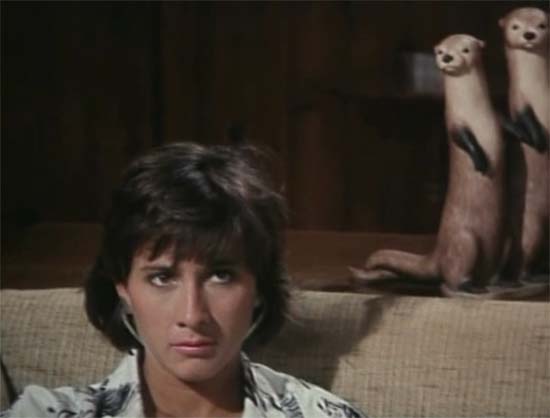
Finner and Ann are left to sort out the killings, but why go to the plot when the plot can come to you? Sitting passively on the couch, they are suddenly interrupted by Evelyn, who leaps in front of them and starts screaming about extremely low-frequency vibrations sucking the Agent Orange out of his cells (his convoluted explanation for the girth of his gut). But “shut up!” screams Old Man Duerst, who also plunges into the living room to berate his son and voice his own theories about what’s going on down by the lake. To which Evelyn responds, “You piss me off you know that! And don’t sneak up on me!” (Exit Evelyn Duerst.) Wally Duerst then tells the tale of Peter’s grandfather, whom Wally accidentally shot in the back with a copper slug while they were fending off a muskie that “got out of control.” But Peter’s grandfather never held it against Wally…he gave him a job instead. Tearfully, Wally leaves the living room. Finner and Ann are left to comprehend all this beneath the eerie presence of two plastic weasels.
Finner’s romance comes to an end when he spies Bev succumbing to the powerful pheromones of Evelyn Duerst. Shortly thereafter, Bev is nearly snagged by the blood hook while taking a midnight swim. Could it be the expert casting of a jealous Finner? Doubtful, since Finner is the hook’s next victim.

But Peter arrives at a theory. Toying with his keyboard, he suggests that the B-flat provided by the song sung by the Red Elbows, combined with the note found in the noise of cicadas, forms “the devil’s tritone, diabolus in musica! Classical music outlawed it for centuries because it made people crazy.” (Footnote: this is actually sort of true.) This theory is further embellished when they find out that old Luedke has a metal plate in his head…so discovered by the application of the stud finder from earlier in the film, remember that? So obviously the devil’s tritone is causing vibrations in Luedke’s metal plate, driving him to commit murder by fishing pole. It’s so simple…why didn’t it occur to them sooner?
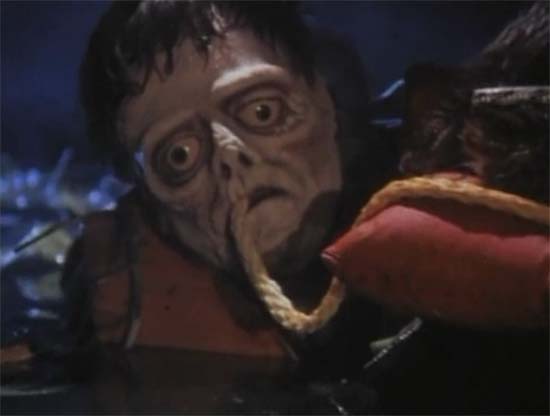
Peter, Ann, and Evelyn head out to investigate Luedke’s bait-shack. While Ann waits down by the pier…meditating…alone…the boys open up Luedke’s refrigerator and find a bucket of bloody organs. “These are your friends, man!” Evelyn declares. When they return to the pier, Ann, unpredictably, has been kidnapped by the deranged Luedke. Conferring with Wally, they form a plan. Rather than, say, using that rifle Wally is holding to go and storm the shack and rescue Ann, they will bait the bait-salesman by sending Peter out onto the lake, listening to the Red Elbows to the din of the cicadas. But Peter, like a lowly coward, cannot bring himself to turn on the cassette player. By morning, their plans in disarray, they reluctantly attend Muskie Madness, trying to put poor Ann out of their thoughts. They are further demoralized when Luedke wins the competition. What can they do? Surely it would be too simple if they were to walk up to the shack while Luedke is at the festival, and let Ann out of the refrigerator? No, this has become personal now, as Peter reveals to Wally:

That’s right, Ann can wait. So that night, Peter once more sets out in the boat, and this time has the courage to listen to that one song by the Red Elbows. Like clockwork, Luedke arrives, and it’s a casting showdown…to the death.

Peter has passed out from his wounds, but once he’s dragged to the shack he quickly recovers. Finally letting Ann out of the refrigerator (she’s okay, thanks for asking), he confronts Luedke just as the sheriff arrives. Luedke escapes, grunting like the Frankenstein monster, and shambling out of frame.

As Blood Hook concludes, the camera pans eerily across the waters of the Wisconsin lake. Luedke is still out there…waiting…you betcha he is.


Posted in Theater Nilbog | Tagged , , , , , , | Comments Off on Blood Hook (1986)

All This and World War II (1976)

As a Beatles fan, I had heard about this film for many years, but was under the false impression that it never actually got made. It’s mentioned as seldom as May Pang. But recently, while I was in the basement of a local record store scavenging through vinyl soundtracks, I encountered a thick box for the double LP All This and World War II. I was astonished. The 1976 release contained twenty-eight Beatles covers from such artists as Peter Gabriel, Tina Turner, the Bee Gees, Keith Moon of The Who, Jeff Lynne of Electric Light Orchestra, Elton John, Roy Wood of The Move, David Essex, The Four Seasons, Helen Reddy, Frankie Valli, and even The Status Quo. My sense of pop culture reality seriously damaged, I returned home and tracked down the film online.  Yes, the film exists. It’s never been released on video, and has had only a few scattered theatrical and television screenings following its brief original run; in the age of the internet, as long as there are like-minded folks, you can find most rarities without too much difficulty. But I can tell you now that when that fateful day occurs and Let it Be is finally released on Blu-Ray so everyone except for Paul McCartney can enjoy it, All This and World War II will remain in the vaults, right alongside the unreleased The Long and Winding Road documentary and other Beatles never-will-be’s. Why? Because the film is so ill-advised and instantly irrelevant that it somehow vanishes into the ether just after you’ve watched it.

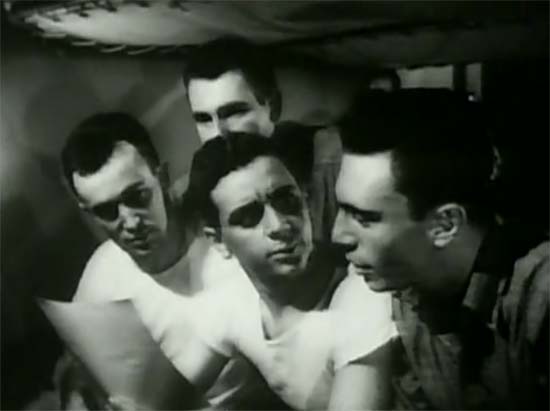
Imagine, if you will, stock footage of World War II. Most of it in black and white, some of it in color. Imagine footage from old Hollywood and British war movies. Imagine that all of this is edited together into a clip show which runs almost an hour and a half, with no narration, and dominated by a soundtrack of Beatles covers. Congratulations, you have imagined this entire film.  Would you like a job at Twentieth Century Fox?

I don’t know that “documentary” is the world to describe this. It certainly documents World War II, in that the footage relates to the subject. One could say that it presents an image of the war as it was experienced by those who lived through it, and simultaneously as it was interpreted into propaganda through Hollywood, but even that modest statement seems to grant the film a goal more defined that it seems to have intended. Watching this film, you really won’t learn that much that you didn’t already know about the war (unless you failed to ever take a high school history class). The goal does not seem to be to educate. And yet, despite the almost nonstop presence of Beatles covers, it does not succeed as a “head” film, either. It’s not very psychedelic, beyond Lennon & McCartney’s occasionally psych lyrics. They don’t ever tint the film or warp the images. There are no Godard-style intertitles punning or making political comment. It is not even edited in a fashion that is remarkable, or very worthy of critical attention.

The thinking, so far as I understand it, is that someone had a large collection of WWII footage and thought it might make a good compilation film. The thinking then advanced, apparently without any words of advice, that said WWII footage would be enhanced by the music of the Beatles. Because who doesn’t love the Beatles? Hitler, that’s who. Yeah, that’s it…we’ll play “The Fool on the Hill” over footage of Hitler in the countryside. We’ll play “Michelle” over footage of troops in France. We’ll play “I Am the Walrus” to accompany the Japanese attack on Pearl Harbor for some reason.

The film’s primary expense, then, would be getting the rights to Beatles music. But wait…what if it were only Beatles covers? That could be cheaper. Then a soundtrack could be compiled, and there would be a hit record to accompany the hit film. Why would the film be a hit? Because obviously everyone loves to watch WWII stock footage while listening to Beatles music. And they love to spend their dollars to have that experience in a theater.

The producers seem to be under the impression that Beatles music can cure all ills, including an excruciatingly poor notion of a film. An understandably giddy enthusiasm for the Fab Four’s catalog leads them down a very strange road indeed. One wonders exactly what sort of resonance is intended by marrying this music to these images. Little is achieved. Those songs which seem to have something to do with the footage (“She’s Leaving Home” over footage of women joining the war effort, for example) do little but state the obvious. The more unusual choices (“I Am the Walrus”) are more sporadically successful at achieving a modicum of interest, or a rare moment of cinematic frisson. None of this justifies a movie.

I keep trying to picture the ideal audience for All This and World War II.  Since the juxtaposition of Beatles music and WWII imagery does nothing for me, perhaps it would for someone who grew up during the 1940’s and listened to the Beatles in the 60’s.  I don’t doubt that screening footage of Winston Churchill, or Eleanor Roosevelt, or dogfights with the Luftwaffe, or storming the beach of Normandy would trigger something more in one who lived through that era, than somebody like me, who knows it as history.  Show this to one of the Greatest Generation, and he might feel these images in his gut…as a younger person might with images of 9/11, or Donald Rumsfeld, or George W. standing before a “Mission Accomplished” sign.  Then again, our culture is one that replays its iconographic images on a loop; we self-obsess, and air documentaries and television specials, and print commemorative issues of Newsweek and Time and sell commemorative coins and plates, and proclaim the cultural and historic importance of this and that in neatly organized top ten lists for every decade.  Raising the flag at Iwo Jima was a stirring image once, but it has become as familiar as the picture printed on a dollar bill.  Fitting, then, that All This and World War II features a scene from a Hollywood movie portraying that moment at Iwo Jima.  Presented now as just another moment in this musical clip show, we’re even further divorced from the ability to feel anything at all about victory in this battle or in the war as a whole.  I hope that the editor felt something, at least.  This movie must be for someone.

What most hurts the film’s chances of enduring the tides of time is that in this day and age, anyone can make a compilation film. Basic video editing programs come standard with most computers. The internet is crammed with amateur works using found footage to stronger effect than what is achieved in All This and World War II. We now think in the language of video editors. It’s become as second-nature as typing on a keyboard or texting with a cell phone. In 1976, before the home video market, musical-clip-show That’s Entertainment had already been a hit and That’s Entertainment, Part II was rushed into theaters, so audiences could relive great moments from great movies. Presumably All This and World War II was meant to do for Twentieth Century Fox what those earlier films had done for MGM. It failed. This might not have happened if it had been a straightforward documentary on WWII, or, alternately, a musical featuring Beatles music. (One that doesn’t star Peter Frampton and the Bee Gees.) Decades later, Julie Taymor’s Across the Universe became a modest art house hit on the strength of using Beatles covers woven into a musical narrative. Her film is exponentially more successful. Then again, she actually made an effort.

Curiosity seekers will still pursue All This and World War II. Do so. Climb that mountain, plant your flag, declare “this film exists after all!”

Or it did, anyway.  But, unlike the Beatles’ songs, this film is of history and constrained to it.  Soon enough you’ll forget you planted your flag, or climbed that mountain, or once wasted an hour and a half of your life.  I’ll say this for the film: it has no sour aftertaste, or any lasting flavor at all.

Posted in Theater Ballroom | Tagged , , , , | Comments Off on All This and World War II (1976)

Repulsion (1965)

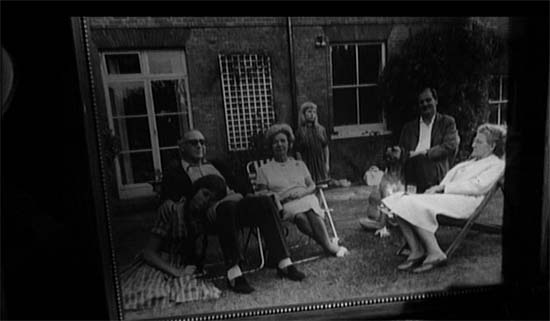
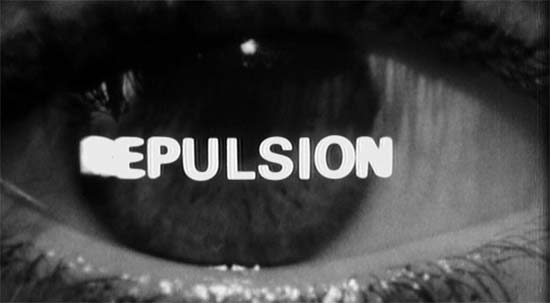
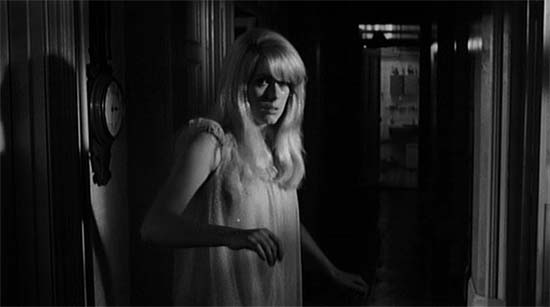
As Repulsion begins, the viewer is inclined to feel sympathetic toward Carol (Catherine Deneuve), a young French woman living in London with her older sister Helen (Yvonne Furneaux).  She might seem a bit detached, but she’s lost in a jungle, albeit a perfectly ordinary one.  Construction workers leer at her.  She daydreams at her salon job, while her client prattles on boorishly.  Her would-be boyfriend pressures her toward an intimacy for which she’s not prepared (and may never be).  Her sister Helen brings over a married man, and has loud sex upstairs; he leaves his toothbrush resting in Carol’s drinking glass.  Roman Polanski delivers these common dilemmas with an exaggerated intensity.  The nuisances might be ordinary, but Carol is not.


One of the most intensely subjective films ever made, Repulsion is perfect fodder for Polanski, whose typical obsession with details mirrors that of his protagonist.  In the opening scenes his camera lingers on moments which any other filmmaker might disregard: nuns throwing a ball around in a fenced-off yard outside Carol’s window, the potatoes on the sill, the awkward little accommodations one must make when sharing the house with an unwanted houseguest, the particularly gruesome-looking skinned rabbit that Helen leaves in the refrigerator.  Repulsion is an accumulation of details, and those details, which repeat, become more sinister as the film progresses, and begin to lapse into the realm of paranoid hallucination.

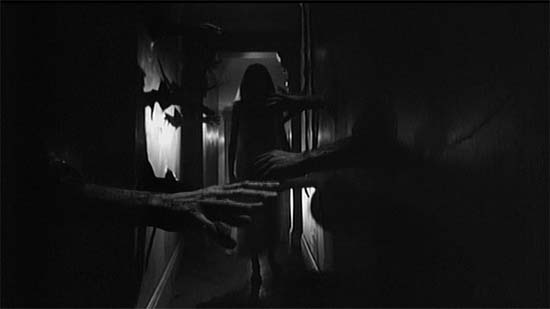
Yes, the film progresses, but there isn’t really a plot.  Carol and Helen are two sisters from Brussels sharing a London flat.  Helen’s having an affair with a married man, and decides to have an extended vacation with him in Italy.  She leaves Carol alone in the apartment, but it quickly becomes apparent that the child-like Carol is not accustomed to independence, and relied fully upon her sister.  Left alone, she begins to abandon her reponsibilities–she doesn’t show up at her job for days, and seems surprised that she’s been missed–and gradually has fantasies, first that there’s an intruder in her apartment, and eventually that he rapes her every night.  These rape scenes anticipate the famous dream sequence of Polanski’s masterpiece Rosemary’s Baby, as the soundtrack contains only the real-world ambience of a ticking clock–likely the clock ticking in her bedroom while she sleeps.  But the ticking is also played during a scene in which she is genuinely assaulted, and responds with sudden violence.  She thinks the walls are splitting apart; early in the film she comments upon a crack in the wall, and her sister barely regards her, but later, as her hallucinations intensify, the cracks grow so wide that the entire building seems to be toppling about her.  In Repulsion‘s most indelible moment, arms reach out of the walls to grasp at her as she walks by.  George Romero later borrowed this idea for a dream sequence in Day of the Dead, but it has a more organic logic in Polanski’s film, for Carol’s greatest terror is of being touched, and she sees the world as a predatory one in which everyone wants to touch and harm her.  Polanski takes his motifs–cracks in the wall, the skinned rabbit, leering men, closed windows–and repeats them over and over, riffing like the jazz music that dominates the soundtrack.  Does the story truly progress or does it just accumulate, until it finally reaches a cacophony, clashing cymbals, and Carol’s actions begin to claim victims just as her inner world, her personal, private horror movie, begins merging with the outer one?

Repulsion is one damn unsettling film.  I have seen it several times before, but this most recent viewing left me feeling more isolated and unnerved than ever.  It is the first film in an informal “apartment” trilogy, followed by Rosemary’s Baby and the underrated The Tenant, which stars Polanski himself as the one being driven insane by apartment life.  To this you could potentially add The Pianist, for its long stretch with Adrian Brody trapped inside an apartment, unable to visit the world outside and at the mercy of his “protectors.”  Even Polanski’s most recent film, The Ghost Writer, fits the theme, as Ewan McGregor’s author is forced to interpret the outside world from tight confines.  Appropriately, Polanski edited the film while under house arrest.  His world is an almost unbearably claustrophobic one, but it’s a privilege to experience it.

Posted in Theater Caligari | Tagged , , , , | Comments Off on Repulsion (1965)