Ellie (1984)

A steamy Southern gothic which incorporates the best elements of Hamlet, Tennessee Williams, I Spit on Your Grave, and Hee-Haw, 1984’s daring, country-music-infested Ellie is a nail-biting exposé of the travails of a vivacious, innocent country girl forced to rely upon her wits and cunning to thwart the Machiavellian plots of the stepmother and stepbrothers who done killed her Pa.

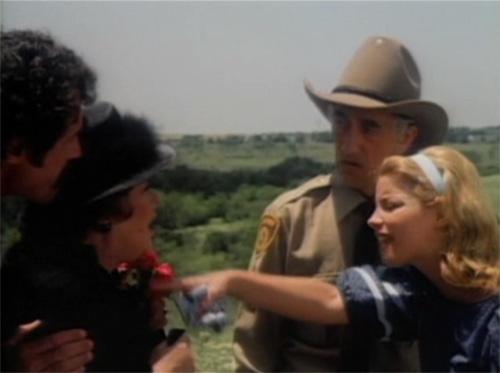
Shelley Winters (Night of the Hunter, The Diary of Anne Frank, The Poseidon Adventure) is Cora, who marries the elderly landowner Sidney Jackson (Tom Matts) and insists he make out a will.  The very next day Cora, Sid, and Cora’s sons are relishing a picnic on a muddy hill overlooking a chilly lake on an overcast day, when a tragic accident occurs involving an out-of-control wheelchair, “Oh Susanna!”, and a delicious leg of fried chicken:

Sid’s daughter Ellie (Sheila Kennedy, Spring Break) insists that Cora and her clan are responsible for her Daddy’s death.  She accuses them outright at his funeral, leading to some Comic Shenanigans in which Cora’s brood stumble backwards into an open grave.  But the local sheriff (comedian and would-be presidential candidate Pat Paulsen) finds no evidence to support Ellie’s claims; further, he’s madly in lust with Cora, understandably.  Ellie will need to take matters into her own hands.  Luckily, she has a secret weapon of her own, as subtly indicated in this beautifully choreographed musical sequence during the opening credits:

Ruthlessly, Ellie begins to dispatch Cora’s sons, using only her feminine charms.  Billy, the photographer of the family, so obsessed with his art that at one point he whines to his Mama that she won’t let him take pictures of her toes, is undone by a grueling photo session with Ellie, in which she willingly poses for what seems to be hours on end, in every acre of the farm and countryside, in the pig pen and on the muddy hills, until at last, as she offers him a picture of her prized birthday suit, he takes a most satisfied tumble backward off a cliff.  Apparently unaware of the notion of an “alibi,” Ellie attends the funeral, where Cora glares daggers at Ellie…and so the chess-like duel between the two women begins.
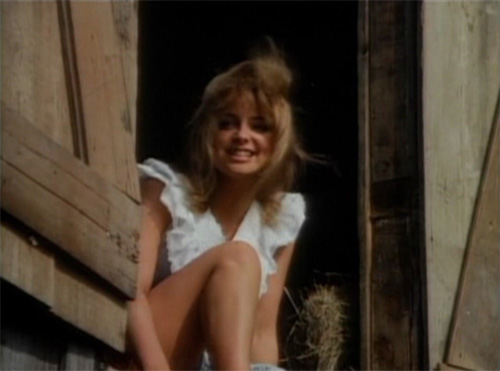
While Cora works her own considerable charms on the hapless Paulsen, Ellie sets to work on the next stepbrother, Frank, who can be distinguished by his other brothers because he’s the one with the cowboy hat and not the camera. Perched atop a barn, with one leg dangling out in a sultry manner, playing with her hair, Ellie coos invitingly at Frank, who does his best to ignore her by shooting beer bottles with his rifle and retorting, “Ma says you’re crazy. Ain’t supposed to go near ya.” But soon, like any red-blooded male, he goes up to the hayloft to play bullfighter with Ellie’s dress. This leads to a spectacular end and an even more spectacular funeral:

But the next brother proves to be marginally more intelligent than his siblings. Tom (Edward Albert, Galaxy of Terror) finds Ellie trying to seduce him at a honky-tonk bar…so identified because the band Atlanta is onstage singing a honky-tonk song, with the lyrics:

Honky-tonk heart
Honky-tonk eyes
Make you believe in those
Honky-tonk lies.

While the band starts their next number (“Wishful Drinkin'”), Ellie lures Tom down to Muddy Lake for a dip. She asks him to dive head-first from the pier, for which she’ll reward him with feminine charmy things, but Tom is wise to her Wile E. Coyote-level plan; she has sawed off the water depth signpost so the water seems deeper than it really is. He insists that she take the dive instead; when she refuses, a chase ensues in which Ellie somehow loses her dress and then her panties, in a complex stunt not attempted since Monty Python’s “Scott of the Sahara.” Tom at last confronts Ellie in a shack, where an attempted rape is undone by the poisonous snake she happens to store under her sheets. Jump-cut to another funeral, where Paulsen complains that “we’re runnin’ out of shovels.” (As anyone will tell you, a shovel can only be used once.)

This war reaches its climax when Ellie lures the last stepbrother into a tryst in the attic of her Pa’s house–which Cora’s trying to flip for a healthy profit–while the prospective buyers are downstairs. So vigorous is their coupling that pillows explode their feathers, and furniture, shelves, a bowling ball, and more sundry items than seen at the Columbus Antique Mall (Columbus, Wisconsin) shake, vibrate, tumble and break. Cora’s last remaining boy dies of a heart attack, and the buyers are scared away by the violent lovemaking. At the end of her tether, Cora chases Ellie out of the house via shotgun.
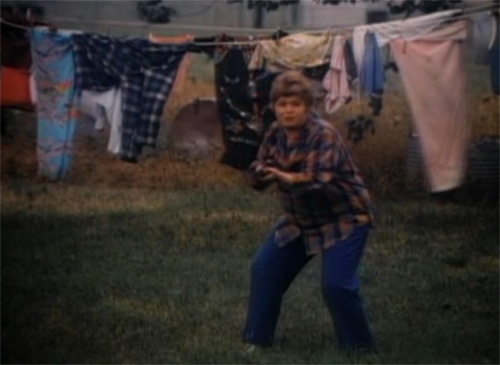
This daylit, buckshot-spattered chase ends with a wrestling match, when inexplicably it’s nighttime and the sheriff arrives, apparently because that’s how late it took before Pat Paulsen arrived on the set that day, and the two women emerge from the mud with their dignity intact. Turns out the sheriff has evidence Cora’s murdered old Sid; who could have predicted that Billy’s photo essay of the drowning might actually make a late-plot arrival to settle all events? Cora is arrested, and Ellie thanks the sheriff for listening to his heart and not his nether regions when the evidence passed into his possession.

Still, in the grand tradition of Shakespearean comedy, Ellie must end with a wedding, as the sheriff and Cora tie the knot anyhow.
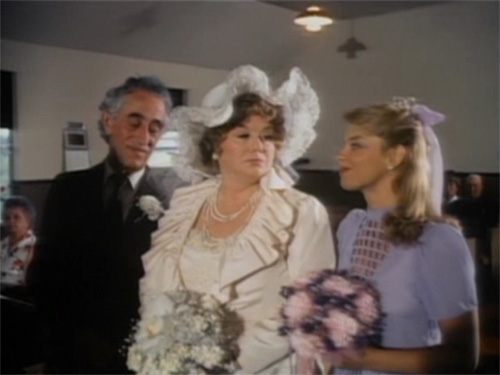
The song stylings of Charley Pride and Atlanta, which have only been absent for approximately three minutes of the entire film, rise once again to accompany the ending credits when we are reminded that yes, the great Shelley Winters was still active and working in 1984.
Posted in Theater Nilbog | Tagged , , , | Comments Off on Ellie (1984)

Wizards (1977)

Wizards is a film that only seems to make some kind of logical sense when viewed as part of a Ralph Bakshi marathon.  Placed in context within his body of work, sandwiched between the radically cartoonish, venomously indignant Coonskin (1975) and the rotoscoped, literate, epic fantasy The Lord of the Rings (1978), Wizards feels like a natural transitional work, a fantasy with elements of both films knitted into its DNA.  I believe that Coonskin and LOTR are better pictures, though each are flawed.  Nevertheless, Wizards is undeniably fascinating, a film that could be made in no other year: psychedelic, violent, sexy, political, eager to offend, and yet a “children’s film” (Bakshi’s words) rated PG presumably because it has elves and fairies in it.

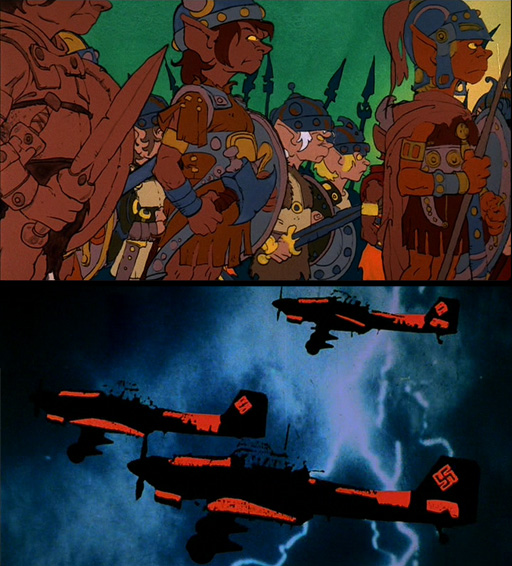
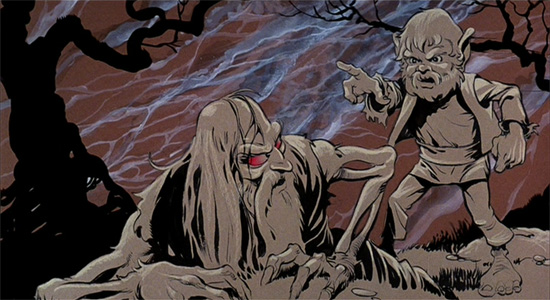
Technically, the film is actually science fiction.  An introduction explains this through live-action footage that segues into illustrations drawn by comic book artist Mike Ploog and narrated by Susan Tyrrell (Forbidden Zone‘s Queen of the Sixth Dimension, and the voice of Juliana in Bakshi’s later fantasy Fire and Ice).   Wizards takes place in a post-apocalyptic Earth thousands of years in the future, in which man is extinct through nuclear war, and new races have taken dominion.  Avatar (Bob Holt) and Blackwolf (Steve Gravers) are twins born from the Queen of the Fairies, though Blackwolf is born disfigured, with skeletal arms and bulging eyes.  Both have inexplicable magical powers, which Avatar uses for good and Blackwolf for evil.  When their mother dies, never having recovered from their difficult birth, the two brothers duel for rights to rule in her seat over the kingdom of Montagar.  Avatar wins, and Blackwolf retreats into the desolate land of Scortch.  As the film begins (“3000 years later”), it is in his exile that Blackwolf uncovers Nazi war propaganda, as well as tanks, planes, and guns, and leads an army of goblins and demons against the peaceful inhabitants of Montagar.

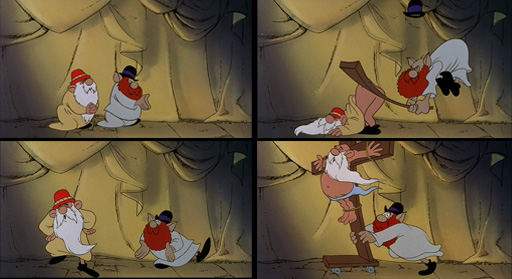
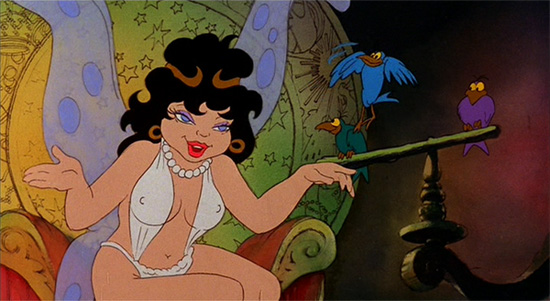
The theme of the film is explicitly stated at the film’s outset: “An illuminating history bearing on the everlasting struggle for world supremacy fought between the powers of technology and magic,” as Tyrrell reads to us off a memorial standing erect upon a parched earth.  So aging, weary, cigar-chomping wizard Avatar reluctantly sets out on a quest to destroy his brother once and for all, joined by a hot-tempered young warrior, Weehawk (Richard Romanus), a large-breasted fairy, Elinore (Jesse Welles), and an amnesiac assassin who was once their enemy (David Proval).  But Bakshi seems uncomfortable, or at least disinterested, in a traditional quest narrative.  He likes to cut away to vignettes of a style closer to his earlier, adult animated films: semi-improvised dialogue, featuring different characters who appear nowhere else in the film, delivering comedy bits wedded to sometimes crude, sometimes interesting social comment.  Such as a scene in which two gas-mask-wearing soldiers in Blackwolf’s army bicker about the horrors of war before one accidentally shoots the other mid-argument, or an interminable bit as two local priests engage in an elaborate pantomime while praying to God for guidance.

This particular sequence can be taken one of two ways.  (1) Bakshi is saying “religion is silly and stupid,” which is hardly incisive satire.  (2) Bakshi is saying “religion is silly and stupid” in a film marketed toward young audiences, which is something more remarkable.   So although the trailer is eager to tell us that the movie is like “Tolkien,” the film’s author is clearly Bakshi, happy to lob bombs wherever he can.

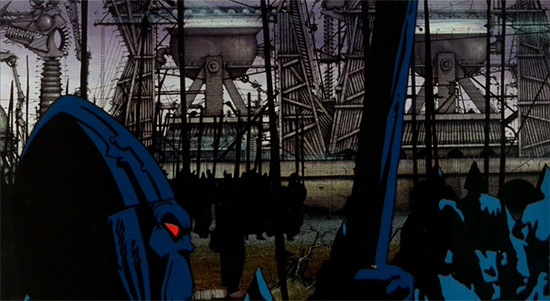
Meanwhile, interludes in Scortch show Bakshi developing a new technique to save time and money in his animation.  In their book Unfiltered: The Complete Ralph Bakshi, authors Jon M. Gibson and Chris McDonnell describe how the process was accomplished: by feeding 35mm film taken from Eisenstein’s Alexander Nevsky (and other war pictures and newsreels) through new-to-the-market photocopy machines.  This process resulted in “high-contrast graphical shapes on long spools of paper that had to be manually cut, aligned, pasted onto punched animation paper in just the right location, and finally photocopied onto cels in order to work.”  The result is oddly haunting, mainly because it looks so weird.  It is quite evident that one is seeing live action footage incorporated into the animation, however, and leaning on this technique too heavily kills the effect.  It happens in Lord of the Rings, and it happens in Wizards. (Bakshi had been blending the two worlds in one way or another ever since Fritz the Cat, and this aesthetic reached its height in the semi-autobiographical Heavy Traffic.  Bakshi would never again integrate live action footage and cartoon characters with such resonance.)

There are some traditional fantasy sequences of the 70’s sword-and-sorcery variety (the genre was in vogue): the heroes encounter some wicked fairies, battle a monster, and briefly Avatar and Elinore are exiled through sorcery into a vast and snowy wilderness.  But Bakshi hadn’t yet learned how to sustain a traditional narrative; it sometimes feels like more of a cartoonist’s sketchbook than a proper movie.  Indeed, like many of his films, there are individual sequences in Wizards which are fantastic, and perhaps the film holds up best when limited to brief clips posted online.  Or viewed under the influence of certain substances (legally obtained, of course)…which, to be sure, helped make it a midnight movie staple in the first place.

I’ve revisited this picture several times, usually leaving with a certain amount of frustration.  I saw it as a child, when the film was completely indigestible to me.  Cartoon characters swearing and shooting bloody holes in one another?  What was this?  I watched it a few times as a teenager, and as a college student reacted to the film by drawing my own psychedelic sword-and-sorcery comic book satire, as a creative reaction, but also determined that I knew how this sort of thing really ought to be done.  Now I’ve owned the DVD for some years and occasionally will still watch it, just recently to see how it would look on a big-screen TV, for a more “theatrical” experience.  The film is still what it is.  Beautiful, ugly, radical, messy.  It is, at the least, an experiment in stretching both animation and genre out of their traditional boundaries, and for that, it will probably be worth revisiting again.

Posted in Theater Inkwell | Tagged , , , , , , | Comments Off on Wizards (1977)

House (1977)

My favorite movie subgenre is the haunted house film.  Jack Clayton’s The Innocents (based on Henry James’ Turn of the Screw), Robert Wise’s Shirley Jackson adaptation The Haunting, Lewis Allen’s The Uninvited, John Hough and Richard Matheson’s The Legend of Hell House, Stanley Kubrick’s The Shining, and more recent films like The Others (which inverts the genre), The Devil’s Backbone, The Orphanage, and Paranormal Activity all illustrate how much drama can be generated from the simplicity of actors reacting to bumps in the night—perhaps the most immediately relatable of horror film tropes.  The best of these films take the Val Lewton ethos of using shadows and implication—noises beyond walls, shapes glimpsed in dark corners, and a suffocating helplessness—to generate fear and dread.  Typically this is all draped in some lovely Gothic accoutrements.

And  then you watch a spookshow like Nobuhiko Obayashi’s House, and none of these rules apply, and you don’t even know what the hell you’re looking at.

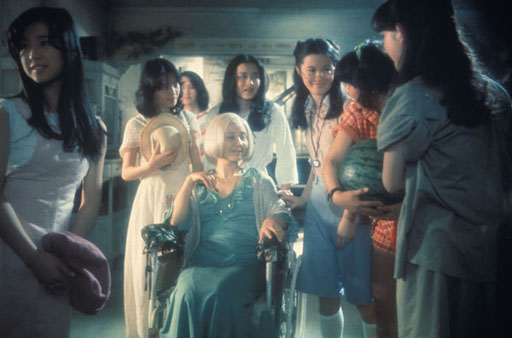
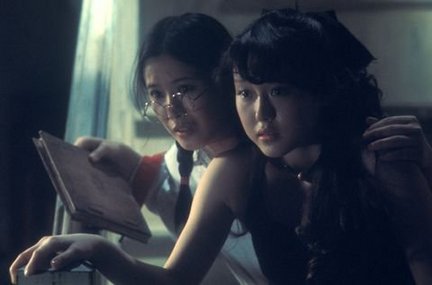
Schoolgirl Gorgeous is upset that her father is remarrying (a woman who is perpetually shot in slow-motion while a fan kicks up her fluttering hair); so she runs away with her six friends to spend a holiday with her aunt, a widow who lives in a towering, menacing House! severed from the real world by a high wall.  (Not that the real world is in evidence on either side of that wall, in this particular film.)  All the girls, like Snow White’s seven dwarves, have names which describe all you need to know about them.  Apart from Gorgeous, there is Fantasy, Prof, Melody, Sweet, Mac (the chubby one), and my favorite, Kung Fu, whose skill seems to be kicking objects out of the air as they hurtle toward her head while a frenetic 10-second loop of library music plays, and who spends the last half of the film, pleasingly, without any pants.  The last companion on their candy-colored, pop-music-driven journey* to Auntie’s House is a mysterious white feline with glowing green eyes and an apparent working knowledge of train schedules.

Once they arrive, twenty-five minutes into the film, the wheelchair-bound Auntie greets the girls warmly, but events start going haywire pretty quickly.  Shortly after they step through the door, the following sequence occurs, lasting only a few seconds.

1) Melody’s hat flies off her head on a vertical path.

2) Kung Fu spins around dramatically.

3) Red and green flashes light up the chandelier overhead, and a pointed crystal shard drops from it.

4) Kung Fu dodges the crystal shard.

5) The shard impales a lizard on the floor.  Its tail wriggles.

6) Melody screams while the room spins about her.

7) Slow-motion zoom on Kung Fu.

8) A shot of Kung Fu leaping through the air toward the chandelier is fast-intercut with a shot of the cat on a similar trajectory, apparently leaping at least seven feet off the ground.

9) Kung Fu’s hand karate-chops another dropping crystal shard.  This shot is so brief that you can barely see it without pausing the film.

10) The shard flies horizontally toward an antique telephone hanging on the wall.

11) The shard becomes lodged in the mouthpiece cup of the telephone.

12) Kung Fu lands on the floor.

13) Melody’s hat drops back onto her head.  She says, “Well done!  You’re so cool, Kung Fu.”

14) The cat walks over to the impaled lizard and begins to eat it.   This is followed by an iris-in transition to blackness to end the scene.

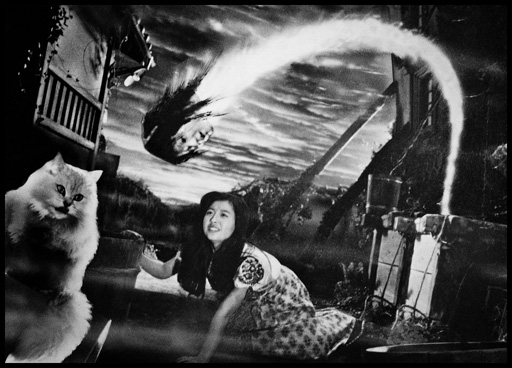
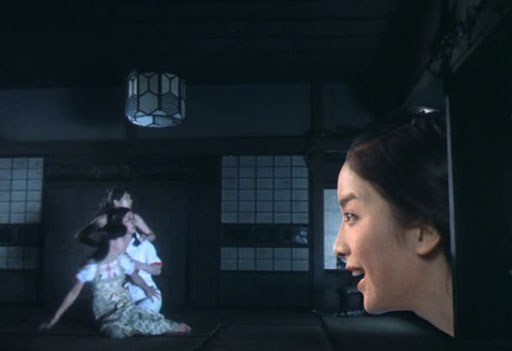
Although this is an extreme example, much of House is like this.  Obayashi acts more like the director of an animated short—say, a Chuck Jones—than anyone who had hitherto worked in the house of Toho.  The casual surrealism is more pop-art (and Saturday morning cartoon) than Buñuelian, although Buñuel, in the unlikely event that he ever saw the film, might have enjoyed the trippy sequence just a short journey further in, when Fantasy goes in search of the missing Mac.  After commenting on the “beautiful sunset”–a deliberately artificial matte painting–she pulls at the rope of a well, intending to retrieve the watermelon sunk there earlier, in lieu of a working refrigerator.  Rather than the melon, she pulls up Mac’s severed head, which grins at her and calls her name.  Fantasy screams and flees, and Mac’s head floats through the air, spins, and swoops down to bite Fantasy’s behind.  “Tasty!” she declares.  Then the head is flung back to the well, where it vomits bloody well-water, and drops clumsily backwards.  Alas, when Fantasy returns with her friends in tow, no one will believe her story, for her name is Fantasy, after all.

Very soon all the girls will realize something is horribly wrong with the House.  Disconcerting enough that Auntie doesn’t seem to really need her wheelchair after all—oh, and is briefly glimpsed chomping on an eyeball.  But shortly after Mac’s disappearance, Gorgeous has a ghostly encounter in the bathtub, Kung Fu is attacked by pieces of flying firewood, Auntie dances with both the cat and a string-operated skeleton, and, in the film’s tour de force, Melody becomes possessed by the piano she is playing, and is then eaten by it, piece by piece, until only her severed fingers are left playing the keys.  This memorable scene is accomplished using the same bizarre style of special effects which permeate the entire film: choppy bluescreen work, animation of various styles, and such extreme stylization that it evokes an underground film aesthetic as well as the notebook doodles of a distracted schoolboy.  It’s also edited within an inch of its life.  Obayashi barely lets a transition pass that isn’t ingenious in one way or another; my favorite is when a man stuffing his face with noodles suddenly plunges into a sequence in the House, grotesquely leaning right into the girls’ faces—cut to that man in the noodles shop some several miles distant for a scene which then proceeds as normal.  When I first saw this film, on the revival circuit last year, such relentless innovation was exhausting.  As much as I enjoyed the film, I was ready for it to end about twenty minutes before it did.  But House gets better, and certainly less exhausting, on repeated viewings, as you begin to notice more details (and jokes).


By the time of the film’s release in 1977, House was only the latest installment in a rich cinematic lineage of Japanese ghost stories.  Nonetheless, the playful, postmodern approach of Obayashi—a contemporary of the groundbreaking Japanese New Wave, and a bold experimentalist in both short films and television commercials before making this, his belated debut feature—was a radical departure for Toho Studios, and pointed the way toward the greater extremes of self-conscious Japanese pop-art that would soon begin appearing more frequently in Japanese films, television, and manga.  As the director describes on the recent Criterion Blu-Ray, prior to House’s release there was a radio adaptation, manga, novelization, and soundtrack LP; the actual film might have been an afterthought to Obayashi’s media blitz.  But this seems to have given Obayashi greater license to put quotation marks around the material.  House feels like an adaptation of an earlier, non-existent House, like the umpteenth sequel in an old franchise, long decayed into parody and self-referential fun.  Naturally, it could be argued that it’s strictly genre parody, but there’s a great deal of genuine feeling here too.  Beneath all its giddy technique there lurks the angst of an emotionally tortured teenager.**  Fundamentally the movie works right down to its coda, which is both bittersweet and delightfully sinister.

* Pop group Godiego appear as themselves and provide the film’s soundtrack.  They would later provide music for the classic anime Galaxy Express 999.

** Appropriately enough, Obayashi came to specialize in films about teens, including the 1983 film The Little Girl Who Conquered Time, whose unofficial animated sequel, The Girl Who Leapt Through Time (directed by Mamoru Hosoda) is one of the best anime films of recent years.

Posted in Theater Caligari | Tagged , , , | Comments Off on House (1977)