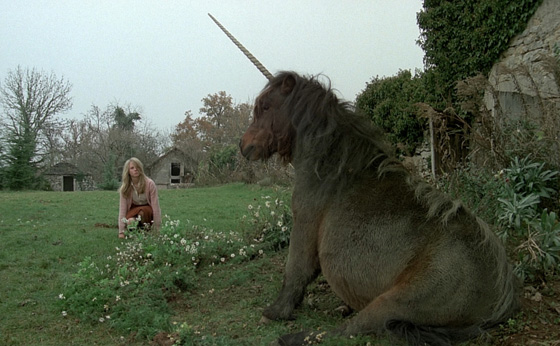
 “The most beautiful things in the world are the most useless. Peacocks and lilies, for instance.” – The Unicorn, Black Moon
I slept through Sunday night until my weather radio blared in the pre-dawn hours, a piercing siren noise. I drearily climbed out of bed, walked into the living room, and pushed the button once to hear the beginning of the severe weather warning, and a second time to silence it to sleep. I drifted back to bed and into dreams, and was woken a few hours later when the weather radio was triggered again. I made my way back, somehow, and pushed the button twice more. And by then it was time to dress for work.
I swear, that exact same siren can be heard in Black Moon, Louis Malle’s experimental 1975 fantasia which I watched later that evening, but in the film it belongs to a large radio transmitter sitting beside the bed of a peculiar and perverse old invalid. Fitting that the radio should migrate into this dream-like film, full of lulling mesmerism interrupted by the unwelcome howl of reality.
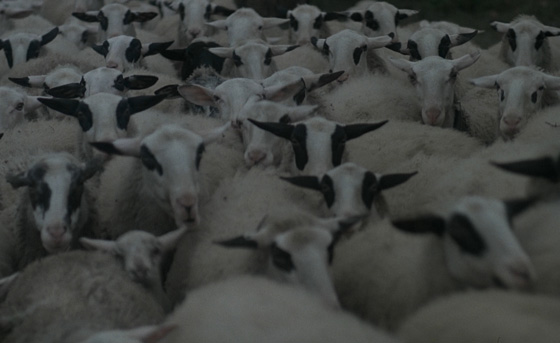 Black Moon spends its first half-hour almost entirely dialogue-free, with no scene-setting explanation; we’re thrust down the rabbit hole and left scrambling to find our bearings. A young woman, whom we later learn is called Lily (Catheryn Harrison, Images), is driving down a remote country road when she accidentally runs over a badger. She steps out of the car and studies the dead creature with both sadness and fascination before continuing her road trip, which is quickly interrupted by a military blockade. They open fire and destroy her windshield when she speeds off the road past them, fleeing into a country idyll which grows increasingly surreal. Naked children herd a flock of sheep and a squealing pig. A mysterious, opera-singing young man (Joe Dallesandro, of Paul Morrissey’s Warhol films) tends to a pile of burning leaves. She catches glimpses of a gray and paunchy unicorn, but it proves elusive. Eventually she begins exploring a chateau occupied by a seemingly deranged old woman, played by Therese Giehse, a veteran German actress who died in 1975, and to whom the film is dedicated. The bedridden old woman talks to a pet rat named Humphrey (who talks back, in barely-discernable squeaks), and reports on all activities to her oversized radio. The harried Lily desperately attempts to please the old woman, and dodge her insults, while investigating her grown children, both also named Lily (Dallesandro and Day for Night‘s Alexandra Stewart), tending to the nude orphans, stepping on talking flowers, struggling to keep her bloomers up, and pursuing that unicorn. As in Ingmar Bergman’s The Silence (1963), the ominous military conflict raging throughout the countryside is left undefined and abstract, lurking in the background with only occasional, violent intrusions into the young protagonist’s world; however, we’re also periodically asked to question whether there really is a war, or if it doesn’t just exist in Lily’s imagination. Along with, possibly, everything else.
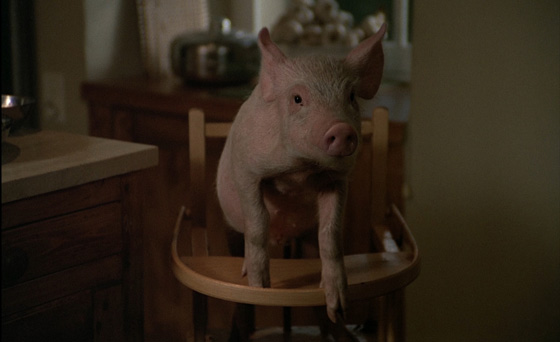 As you probably guessed, the film takes many of its queues from the Alice books of Lewis Carroll, in particular the “Pig and Pepper” chapter of Alice’s Adventures in Wonderland. Ignored by the Disney animated film for obvious reasons, “Pig and Pepper” sees Alice arriving at the house of the Duchess (Giehse bears a strong resemblance to the famous John Tenniel illustration of the character). While Alice dodges tossed plates and sneezes at the pepper which a cook shakes liberally into soup, the Duchess shake her child violently while singing this lullaby: “Speak roughly to your little boy/And beat him when he sneezes/He only does it to annoy/Because he knows it teases.” The sadistic scene ends when Alice steals the baby and runs into the forest, where it promptly turns into a pig. She’s relieved to let the squealing creature run away, with one of my favorite Carroll lines: “It would have made a dreadfully ugly child: but it makes rather a handsome pig, I think.” Surely it’s no coincidence that the first thing Lily sees when she enters the chateau is a pig sitting in a child’s elevated chair. Nor that she can barely strain to reach the glass of milk across the table, which proves to be enormous – as though she had previously quaffed a “Drink Me” bottle. Like Alice, Lily contends with animate flowers, and the unicorn becomes her white rabbit, though when she finally catches it, she can do little but trade insults. (Like expressing disappointment that it’s not slim and white, as she believes unicorns ought to be.) Lest you think this is nothing more than whimsy, Malle keeps the tone muted, periodically somber, and punctuated by hints of sexual awakening and glimpses of stark horror, such as Lily’s discovery of the grisly corpse of a female soldier, pecked at by an indifferent hen.
 Black Moon was once one of the more obscure entries in Malle’s long and impressive catalogue, but it’s now, at last, receiving a much larger audience thanks to the Criterion Collection’s new release to Blu-Ray and DVD. Presumably it languished for decades because it’s “difficult” without having received the kind of critical acclaim that can rescue such experiments, but to the modern film buff, to come across a “lost” gem like Black Moon is a revelation.
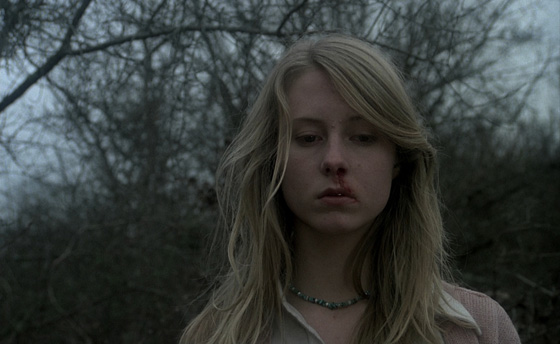
Photographed by the great Sven Nykvist (Persona, Cries and Whispers, The Sacrifice, etc.), it is staggeringly beautiful, especially in high-definition. Just look at the early shot with Lily sitting in her car, her face sheathed in very dim, pre-dawn light and shadows, but her eyes glimmering. In a poorer presentation than Criterion’s restored print, you’d probably see a black silhouette, if that. But Nykvist pulls every detail out of the low light in his typically expressive manner. When Lily lounges about the chateau, Nykvist highlights her bare leg, or the white of her half-exposed chest, or the red of the blood on her chin, while also summoning every odd little detail of the room around her. The unicorn, when it appears, seems both magical and strangely wrong through Nykvist’s lens – bloated and slouched, in diminished majesty. Even if the events of Black Moon seem too strange to follow, or the pacing too “deliberate” for your taste, the images are too stunning and hypnotic to lose your attention. So polished and intriguing a work shouldn’t have spent this much time in the darkness, not when thematically similar but less accomplished 70’s films like Valerie and Her Week of Wonders (1970) and Lemora: A Child’s Tale of the Supernatural (1973) have long since seen release on DVD, and subsequent appreciation.
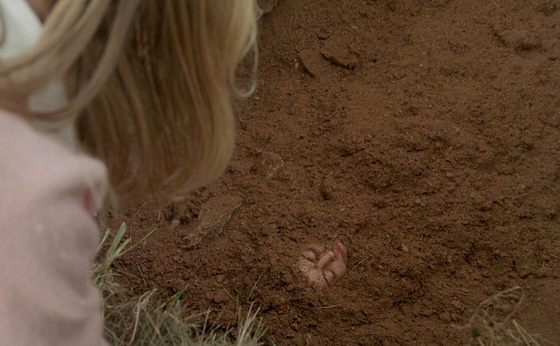 Like those films (as well as Neil Jordan’s 1984 fantasy The Company of Wolves, a sibling in spirit), Black Moon flows with the illogic and intensity of a dream, at its center a girl hesitating on the boundary between childhood and maturity. And also like those films, it’s saddled – and sometimes unduly weighted – with Freudian sexual symbolism. In this particular subgenre, the psychosexual fantasy, heavy symbolism comes with the territory, and it’s hard to deny the potency of images like a slender snake creeping up the skirt of young Lily reclining on a bed, no longer moved to protest. Obvious? Well, it works. Though Black Moon sometimes risks pretention, Malle’s mischievous black humor and talent for visual non sequiturs keep the film entertaining and, oddly, elevate the intensity. (This style also aligns his film more closely with Lewis Carroll’s work than many other homages and adaptations. Perfect, too, that the credit for “additional dialogue” goes to Joyce Buñuel, daughter-in-law to surrealist director Luis.)
What makes Black Moon a bit more intriguing than some of the other films I mentioned is that it’s not just sexual maturity which awaits the central female character. It’s the wider world of adulthood: politics, love, tragedy, responsibility and duty – even if those things might seem absurd when they arrive. Whatever is or isn’t real (and, frankly, it doesn’t matter what’s in Lily’s imagination and what isn’t), there is the great dark world waiting for her at the outer fringes, and it’s constantly impeding and demanding attention. Black Moon charts her journey into that world, with either resignation or acceptance, depending on how you read the final haunting scene.
Black Moon does reward curiosity, and so you want to decode and unpack every strange little riddle, such as how Dallesandro communicates with Lily – by speaking through touch, it seems – or just what that bloody painting means and why it has to be reenacted following an impromptu performance of Wagner’s Tristan and Isolde. You won’t always be rewarded by direct answers, but an intuitive sense that it all fits together, in the same way that a dream or nightmare does, or a film by David Lynch. It might be inexplicable, but it’s fully realized, satisfying and whole.
[Note: I usually try to take my own screenshots for this website, but on occasion I have to borrow from other online sources. As I viewed the Blu-Ray of the film, and don’t have a Blu-Ray hard drive on my computer, these screen captures are from the ever-reliable dvdbeaver.com.]
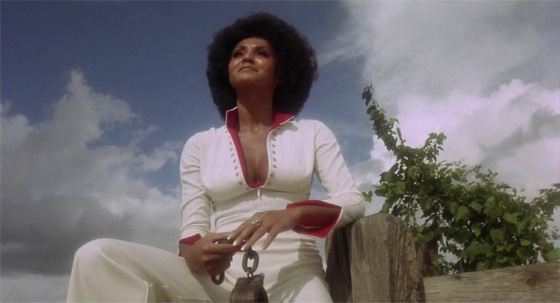 Mob boss Mr. Morgan (Robert Quarry, Count Yorga, Vampire) wants to buy the Club Haiti, a groovy joint with live voodoo acts every night. But owner Langston (Larry D. Johnson) won’t sell, so Morgan’s thugs beat him to death one night in the club parking lot. Langston’s fiancee, Diana “Sugar” Hill (Marki Bey), enlists her police detective ex-boyfriend, Valentine (Richard Lawson, Scream Blacula Scream), to investigate the crime. “You know, if I knew who they were, I would fix it so one by one I could see them die…slowly,” Sugar Hill vows. The very next scene, she’s visiting a spooky old house where she encounters Mama Maitresse (Zara Cully), a white-haired old woman who chides her: “You have always been a nonbeliever. Why do you come to me now?” “Because I want revenge!” Sugar Hill declares…and so the ceremony begins.
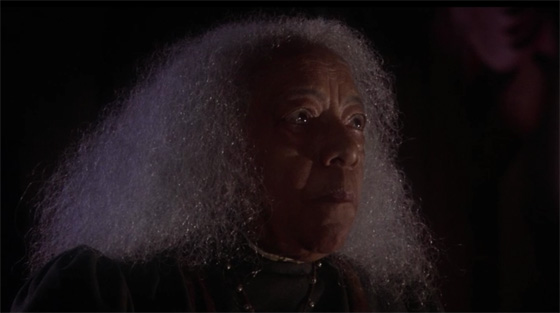 Mama Maitresse leads Sugar Hill into the swamps, amongst stock footage of alligators and snakes, as a smoke machine chokingly fills the screen. Deep in the woods she summons Baron Samedi (Don Pedro Colley, THX-1138), the voodoo god of the dead. (You’ve seen Live and Let Die, right? Same guy.) In sunglasses and a top hat, with a bone earring and wielding a smart-looking cane, he immediately cops an attitude, albeit with an ominous elongation of vowels: “Woman, who are you? I am Baron Samedi. This is my domaaaain. A kingdom of the deeeead!” Hastily Sugar Hill promises her soul in exchange for a few zombies, but Samedi scoffs: “What’s this talk about souls, woman? Ain’t souls I’m interested in.” We never do learn what he’s interested in, though he does have a few zombie brides who hang out at his side, so that might be a clue. He hands over the zombies (“Put them to evil use – it’s all they know or want”), and Sugar Hill sets to work dispatching her enemies.
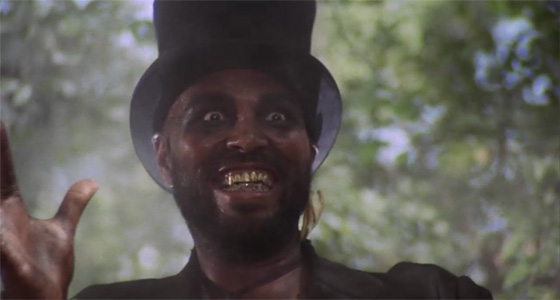 The American International/Samuel Arkoff production Sugar Hill – the only film directed by Paul Maslansky, producer of the Police Academy films – has only the vaguest dressings of a blaxploitation product. It is, by definition, but its heart doesn’t seem in it. Take this pretty representative scene, as Sugar Hill confidently sics her zombies on her first victim. Is this really about revenge against the White Man, or just an expression of deep-seated love for monster movies and spooky makeup? I don’t quite buy the line, “I’m not accusin’ you, HONK.” But at least everyone seems to be having fun.
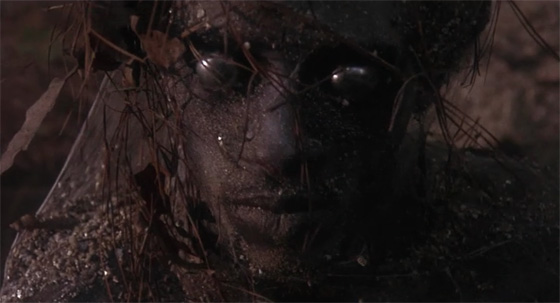 Therefore it shouldn’t be too surprising that the story is construction-paper thin, and as a film it’s pretty disposable. With a ho-hum subplot about Valentine trying to uncover who’s behind all these murders, and Robert Quarry getting mildly agitated as his minions are snuffed one by one, it gets to be repetitive pretty quickly. The climax, rather than offering any complications, simply wraps up the revenge killings and cuts back to that funky theme song, “Supernatural Voodoo Woman.”
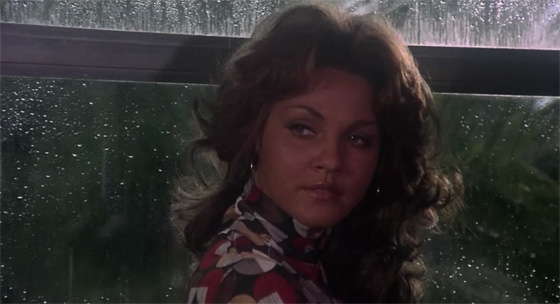 On the positive side, Marki Bey is fetching, though Pam Grier could probably deliver the role with a bit more venom. The zombies, yes, do look pretty cool, despite the bizarre decision to drape them in cobwebs and to paint ripped abs onto their stomachs. Frankly, I’m always partial to a zombie film that’s rooted in Haitian folklore rather than George Romero, especially since pop culture is currently oversaturated with the latter. There’s also a novelty factor which takes Sugar Hill a certain distance – but only so far.
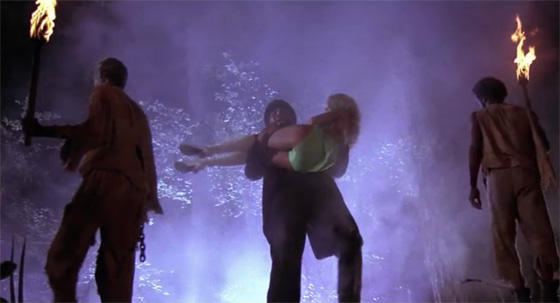 The problem is that the film was made with such modest expectations that no one – not Maslansky, nor the screenwriter, Tim Kelly (Cry of the Banshee) – puts any great effort into making this drive-in fare something special. After the first couple of zombie killings, the film gets pretty dull; though one might be mildly diverted by a death-by-animate-chicken-leg. In the rich tradition of voodoo cinema, from White Zombie (1932) through I Walked with a Zombie (1943), and even The Serpent and the Rainbow (1988), there’s little reason to remember Sugar Hill. Check out some 1970’s Brother Voodoo comics instead. Seriously – he’s a Marvel superhero with voodoo powers. Why didn’t AIP buy the rights?