 I was slightly reluctant to revisit the 1981 Roger Corman production Galaxy of Terror, but quickly realized, five or six minutes in, that the film I remembered disliking – that which I’d seen on cable a long time ago – was actually Forbidden World, the 1982 followup which reused the same sets. Luckily for me, Galaxy of Terror (recently made available on BluRay from Shout! Factory as part of the “Roger Corman Cult Classics” series) was not only something I had never seen before, but the superior product. Granted, you need to set your expectations accordingly. Famously known as an Alien rip-off (one of the many which emerged in the late 70’s and early 80’s), it’s a typical lowbrow Corman/New World production from this period, tasteless and exploitative in a manner which cult film buffs of a certain age tend to view with nostalgia. But to revisit Galaxy of Terror three decades later, one sees a film which, however daffy, exhibits more imagination and ambition than most films of its ilk, with special effects and set design that, for the most part, look much better than they cost.
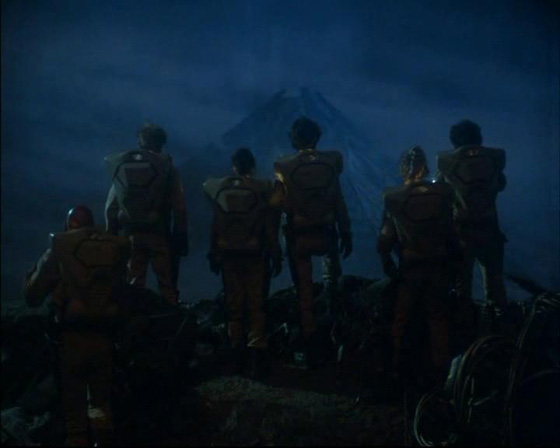
 First, surely, one needs to approach Galaxy of Terror as an exploitation product, with equal emphasis on both of those words. The initial directive, issued from Corman, was to clone Alien, and hopefully duplicate some of its box office success. Science fiction horror was all the rage: we’d quickly get the likes of Saturn 3 (1980), Humanoids from the Deep (1980), Xtro (1983), Lifeforce (1985), Creature (1985), and even an Alien parody, Spaceship (1983), with Cindy Williams and Leslie Nielsen. Marc Siegler and Bruce Clark penned a screenplay which placed the Alien storyline into a purely Freudian context (as though the original film were short of Freudian overtones); rather than being stalked by a single deadly creature, the crew of the Quest faced a metaphysical conflict. Summoned to a towering pyramid on the desolate planet Morganthus, they are subsequently killed off, one-by-one, by their own worst fears. Corman approved the script, which Clark would direct, and only asked that they add a rape scene. Just a little one. For the foreign markets. At first horrified, Siegler and Clark ultimately elected to include a rape scene so absurd that it would sail past offensiveness and straight into another realm entirely – that of a bad acid trip.
 The secret weapon in Galaxy of Terror‘s arsenal was its effects unit, which featured a number of artists who would go on to bigger and better things. Chief among them was James Cameron, head of the special effects department for New World and quickly climbing the ranks; he oversaw all the effects work on this film and also served as assistant director. Roger Corman was famous for creating an environment that groomed talent: Jack Nicholson, Joe Dante, John Sayles, and Jonathan Demme all graduated from his B-movie schooling. Cameron also rocketed through Corman’s system, though his first stop as director was, unfortunately, Piranha Part Two: The Spawning (1981), before beginning his auteur career proper with The Terminator (1984). His design work in Galaxy of Terror is immediately identifiable. The blue-hued, misty, awe-inspiring sets and miniatures on display are mostly done in-camera, and strongly resemble the apocalyptic scenes in The Terminator and the fearsome planet “LV-426” in Aliens (1986). It might be irony that the director of an Alien cash-in would one day direct the official sequel, but Galaxy of Terror proved he could capture the required look and atmosphere.
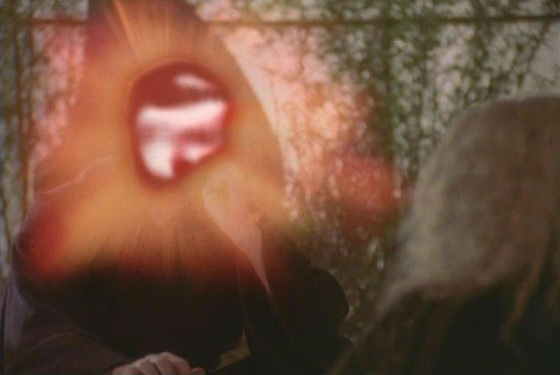
 But this is, of course, a long way from Aliens, and Galaxy of Terror, for all its nifty effects, has a plot more suited for a bizarro 1970’s David Carradine vehicle. In fact, it’s a great shame that Carradine isn’t present, because he’s a perfect fit for “The Master,” the mysterious character with a brightly glowing head who summons the space explorers so they can play his deadly game. (Either Carradine or Alejandro Jodorowsky – but then it would be a very different film.) The crew is ostensibly following an S.O.S. call, a la Alien, but the spaceship which issued the call is filled with dead passengers, and as soon as they begin exploring the nearby pyramid, the body count immediately escalates.
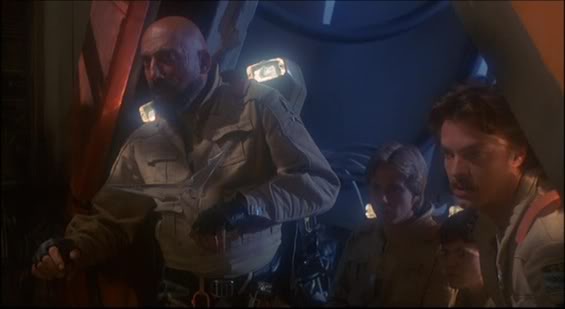
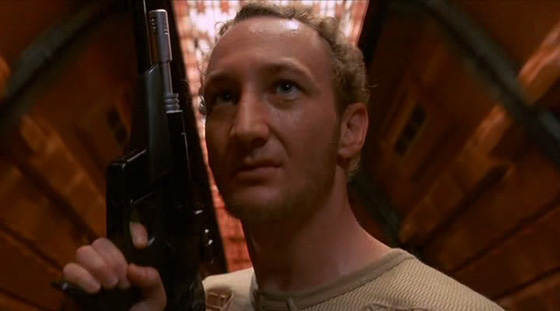 Along for this ride is a cult movie dream cast: Edward Albert (son of Green Acres star Eddie Albert) as the cool-headed hunk Cabren; Erin Moran (Happy Days and Joanie Loves Chachi) as the Deanna Troi-like empath Alluma; My Favorite Martian‘s Ray Walston as the cerebral Kore; a youthful Robert Englund (A Nightmare on Elm Street) playing Ranger; Zalman King (future director of erotic dramas like Wild Orchid) as Baelon; Grace Zabriskie (Twin Peaks) as the unhinged Captain Trantor; Bernard Behrens (The Changeling) as Commander Ilvar, and veteran character actor Sid Haig (The Devil’s Rejects) as a mercenary with giant ninja stars. Watching Joanie Cunningham, Freddy Krueger, and Captain Spaulding stalk dark alien corridors with laser rifles in their hands can send your junk-culture synapses crackling like pop rocks.
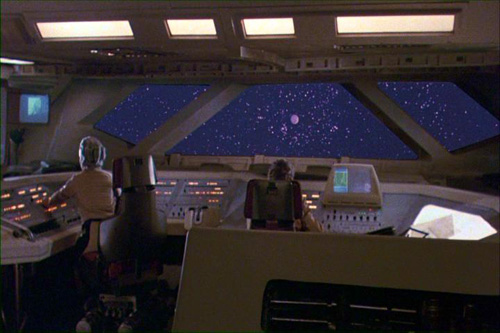
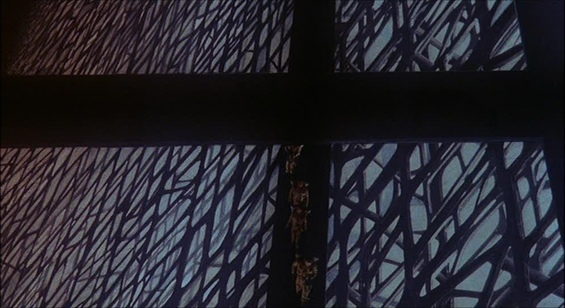
 The dialogue they’re required to deliver is nonsensical at best, incoherent at worst. No wonder Sid Haig decided to throw out almost all of his lines (except for “I live and die by the crystals!”). Alluma gets to say, “Phaelon, I’m psi-sensitive. The subtle energies do exist. They even pay me to sense them, all right?” Ray Walston solemnly intones all sorts of mumbo-jumbo as his alter ego, Planet Master Xerxes. Unlike Ridley Scott’s film, which constantly hints at a larger science fiction universe, everything in Galaxy of Terror is skin-deep. The Quest corridors are impressive-looking at first, until you realize those are styrofoam hamburger containers pasted and spraypainted on the walls. In the first scene in the film, Xerxes orders Commander Ilvar to “put together a Class III ship, with normal exploratory and defense equipment.” A few scenes later, we’re treated to a close-up of a monitor displaying the Quest’s stats, and offering in bold letters: “Class III Mission Ship: Standard Compliment of Exploratory and Defense Equipment.” One doubts there was a Galaxy of Terror bible written for the crew to consult.
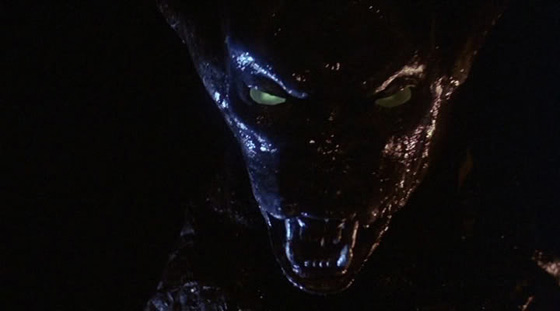
 But for B-movie fans, many of the ridiculous touches are just lovely. When medical officer Dameia (Taaffe O’Connell) is conducting an autopsy with Robert Englund’s Ranger, she turns to the camera and wipes her sweaty brow with a blood-covered hand. Just before the scene cuts, the equally bloody Englund wipes his mouth (!). Earlier, we’re treated to Zabriskie’s Captain Trantor exhibiting borderline psychotic personality disorder as she speaks in a creepy, haunted voice about the earlier, disastrous mission for which she was in charge (“Hesperus!”) before she abruptly gives the crew thirty seconds to prepare for launch, and then no warning before she plummets the ship into a landing maneuver. (“I got you here,” she sneers at Commander Ilvar, “the rest is up to you!”) The ship’s coward is killed off immediately – by a Gigeresque xenomorph that scalps him – and, upon exploring the pyramid, Ilvar quickly follows. Taking the film at its word that these deaths represent the crew’s worst fears, one assumes Ilvar was really afraid of being punctured bodily by slimy tentacles.
 And Haig’s “Quuhod” – named, perhaps, when Marc Siegler passed out on his keyboard – must have been deathly afraid of his own throwing stars, which you need to reconcile with the fact that he’s been brandishing them with pride throughout the film. His ninja-star death scene is elaborate, to say the least. One of the blades launches into his arm and begins working its way upward, crawling beneath his flesh. Without a moment’s hesitation, Quuhod lops off his own appendage…at which point the severed arm throws the star back at him, killing him instantly. Dameia later discovers the limb, now crawling with maggots. One of the maggots, via stop-motion, grows to giant-size, and lumbers on top of her. Pressed beneath its slime, her clothes promptly vanish, and the maggot has its way with her squirming body. Corman reportedly directed this scene himself, because you don’t want to mishandle slimy maggot rape.
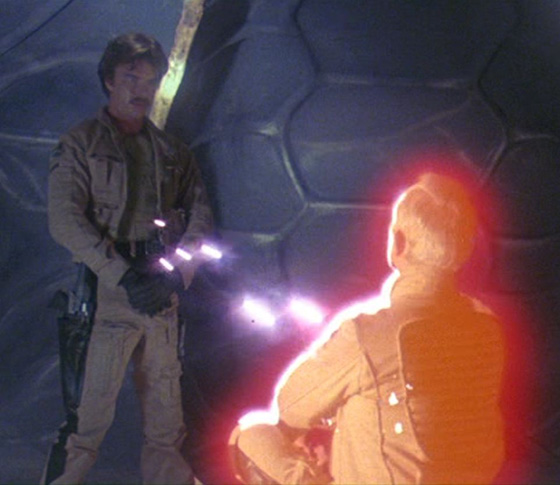 Of the remaining crew, only Erin Moran’s Alluma and Edward Albert’s Tom Skerritt-like Cabren seem to stand a chance at conquering the pyramid’s horrors, but when Alluma finds herself squeezing through a claustrophobic tunnel, tentacles erupt from all sides and squeeze her to death. If you want to see Joanie Cunningham’s head explode, Scanners-style, this is the movie for you. Cabren confronts the Master, now revealed to be Ray Walston, and learns that the pyramid is a “child’s toy” (apparently with the warning label removed) built by an ancient race to allow them to conquer their fears. Cabren, after facing off against the living corpses of his crew, manages to destroy the Master by firing lasers from the center of his body. (See, how can David Carradine not be in this?) He now becomes the Master himself, for a sequel that never arrived, unless you count the generally unrelated Forbidden World.
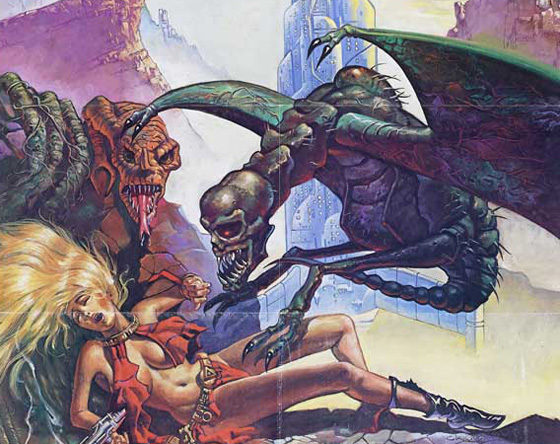 The shooting title was Quest, with the intention of changing it once they’d tricked some respectable actors into signing on. Galaxy of Terror was the most common title upon release, though it went out in some areas as Mindwarp: An Infinity of Terror. The Shout! Factory release includes a reversible sleeve, so you choose which title and poster you like. It’s hard to beat Galaxy of Terror‘s iconic, pulpy art, featuring a large-breasted blonde ravished by a phallic winged demon, though Mindwarp does offer its own addled take on Alien‘s famous tagline…”It’s always midnight in space!”
 “I’m William Castle, the director of the film you’re about to see. I feel obligated to warn you that some of the sensations, some of the physical reactions which the actors on the screen will feel, will also be experienced, for the first time in motion picture history, by certain members of this audience. I say ‘certain members’ because some people are more sensitive to these mysterious electronic impulses than others. These unfortunate, sensitive people will at times feel a strange tingling sensation. Others will feel it less strongly. But don’t be alarmed: you can protect yourself. At any time you are conscious of a tingling sensation, you can obtain immediate relief by screaming. Don’t be embarrassed to open your mouth and let it rip with all you’ve got, because the person in the seat right next to you will probably be screaming too. And remember this: a scream at the right time may save your life.” -William Castle, The Tingler
 With The Tingler, William Castle became the king of the gimmick B-movie, as well as the ultimate showman. His previous picture had grossed a fortune, in no small part to its skeleton, which manifested itself inside the theater concurrent with the skeleton appearing at the climax of the film. To top this, he decided that his new film would be all gimmick – and proudly so. The entire premise of the film would be an elaborate excuse to push the audience into screaming like idiots. As scientist Vincent Price explains to us:
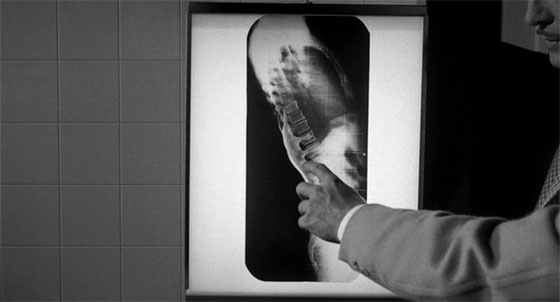 (1) When we become deathly afraid, a creature appears on our spinal column – a slug-like appendage which Price has dubbed “The Tingler.” (His assistant, played by Darryl Hickman, says, “The Tingler. Why not? Since we don’t know what it is yet, we can’t give it at Latin name.”)
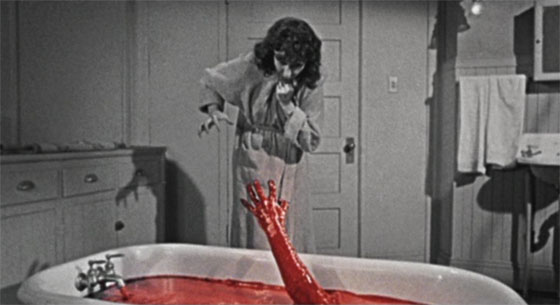
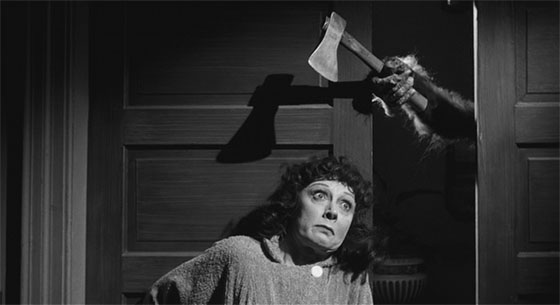
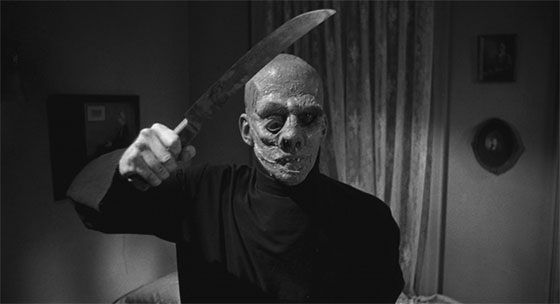 She runs into the hallway, where she’s threatened by a hairy arm with an axe. Taking refuge in the bathroom, she discovers the water in the sink flows with red blood – as red as the blood filling the bathtub, out of which emerges a groping hand. Castle innovatively mixes color with black-and-white footage in these striking images. If that weren’t the topper, then it’s the medicine cabinet swinging open, revealing her own death certificate, which states, “Cause of death: FRIGHT!”
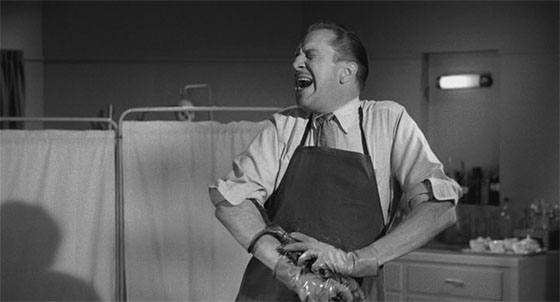
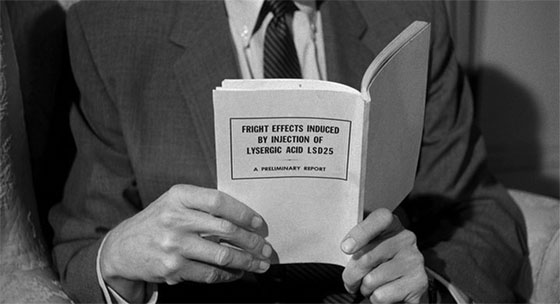
 The premise of the film is both clever and ludicrous, as though inspired by an acid trip. Which makes sense, actually, since Price’s character experiments with LSD as part of his researches into fear, and subsequently partakes in cinema’s first acid freakout, screaming about walls closing in on him (while doing a bit of Marcel Marceau mime) before collapsing on his desk. From the late 50’s onward, Price had a long stretch of working in films that were beneath him – and subsequently elevating the material. But, to put this in Ed Wood terms, he seldom crawled into the pond with the octopus. In this memorable scene, he’s in the pond:
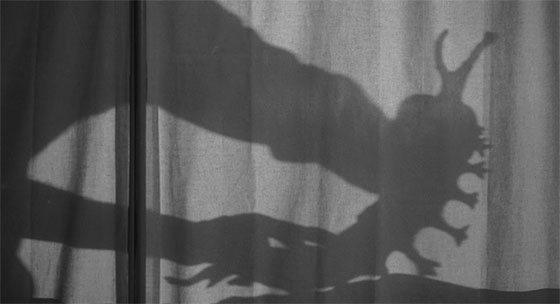
 As you might expect, it’s too late for Price to reverse direction; the Tingler gets loose. And, in Castle’s coup de grace, it escapes into a movie theater (appropriately, Judith Evelyn’s deaf-mute worked in a moviehouse that only shows silent films). We see the slug-like creature wriggling up the aisle and onto a woman’s leg. She screams, and it falls free. At one point, the Tingler reaches the projection booth. The film is pulled from the projector and we see the silhouette of the Tingler (looking like a cheap child’s toy) moving across the screen. Then the lights go out, and in pitch-blackness we hear Price’s voice, speaking now directly to the audience of the film:
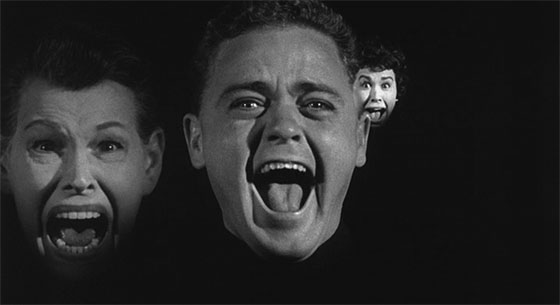
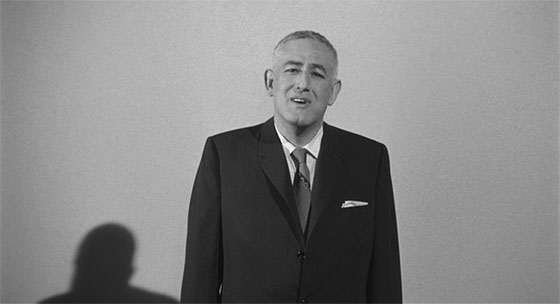 As part of the advertised “Percepto!” experience, Castle had directed theater owners to attach a mechanical vibration device to select movie seats in the theater. At this point in the film, with Vincent Price urging the audience to not panic but to SCREAM, those seats would now vibrate and rattle, hopefully convincing the “unfortunate, sensitive” patrons that the Tingler was on their spines, with screaming the only safe release. He also had a plant in the audience who would scream and then faint, with a fake nurse running down the aisle to escort the poor soul safely out.
 By all reports, the effect worked gangbusters, and the theater would be filled with both screams and laughter. That the climax of the film was essentially an interactive experience, with the audience providing the climax, is a rare achievement. One can imagine that attending one of these screenings was an event, more unique than 3-D. Is The Tingler a great horror film? Certainly not – the direction is workmanlike, the screenplay reliably absurd. (My favorite absurdity being the moment when Darryl Hickman, Price’s assistant, pulls up in a car stating that he brought a dog. We don’t see a dog in the car, but as he steps toward the door to let it out, Price asks, “A dog, what for?” “You say get a cat, I get a cat, remember? You say get a dog, I get a dog.” “We don’t need him,” Price responds. “‘A’ for effort,” Hickman shrugs, walking away from the car and leaving the invisible dog behind. Presumably the poor dog is locked inside the car for the remainder of the film.) But Castle wasn’t after Citizen Kane. He was a showman and an entertainer. He wanted to show teenagers a great time on a Saturday night, and The Tingler, when seen in the right circumstances, surely delivered. As the second film of their brief, beloved partnership, Castle and Price crafted another eighty-minute spookshow ride. You can practically feel the bar dropping down over your lap while Castle personally delivers his (Alfred Hitchcock-like) introduction, and away you go, past the floating screaming faces and down the track. It’s silly and, even in diluted, home video form, tremendously fun.
 The Tingler is available on a 5-DVD box set, The William Castle Film Collection, from Columbia Pictures. Alas, it doesn’t include The House on Haunted Hill (which is available on many public domain editions elsewhere), but it does feature his famous 13 Ghosts (1960), and such rarities as Zotz! (1962), Mr. Sardonicus (1961), and the Hammer Films collaboration, The Old Dark House (1962). I’ll check in here with more Castle reviews as I work my way through the set. You can purchase the box set (and help support this site) through Amazon at this link:

 “The 1970’s. Jump back, baby.”
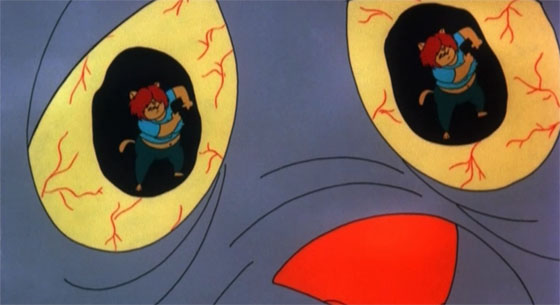
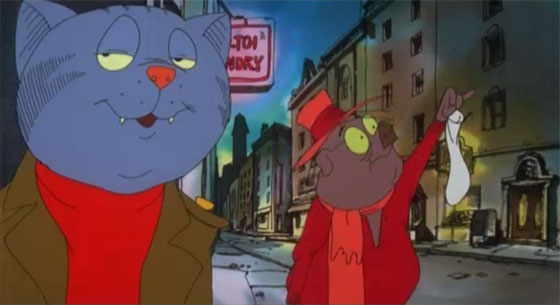 Say what you will about Fritz the Cat (1972), but for at least its first half, Bakshi did attempt to adapt R. Crumb. Eventually he lost the connection, and the second half is a meandering mess, but in the film’s early scenes we get a glimpse of R. Crumb’s style and characters on the big screen. Its sequel, further removed, is even more meandering and random, and frequently crude for crudity’s sake. This wouldn’t be such a problem if there were a few bright shining moments to make the thing memorable. Yet here is a 1970’s adult animated film that somehow manages to be inconsequential, and entirely forgettable. I watched it two weeks ago and I’m struggling to recall the details. (Okay, I imbibed a glass of brandy, but I swear that has nothing to do with it.) The premise is that Fritz, slumped upon the couch, smokes a joint and tunes out his nagging wife for nine separate daydreams. These unconnected vignettes resemble the style of underground comix in that they’re randomly offensive, randomly political.
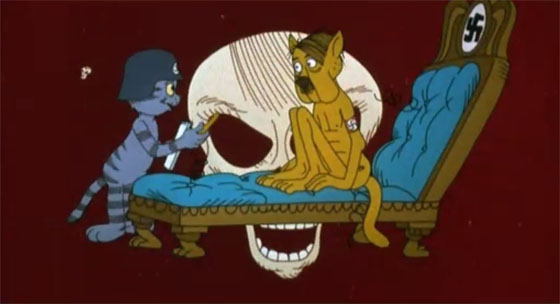 Unfortunately, none of it is really offensive, and if it’s political, it doesn’t actually say anything. This is best illustrated in a protracted scene in which Fritz encounters Adolf Hitler, who is naked, and has a single testicle (much is made of this). Eventually Adolf tries to sodomize Fritz, to Fritz’s understandable alarm. I have no idea what this scene means.
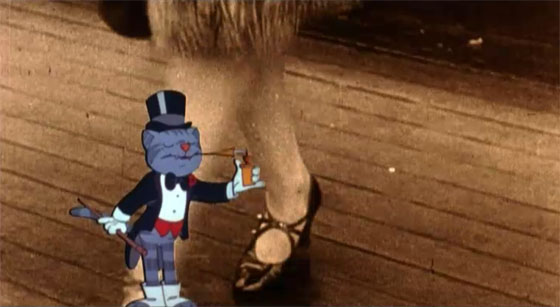
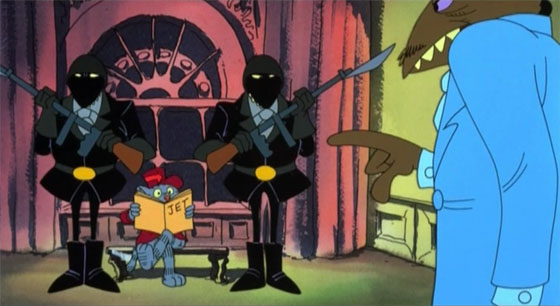 The animation is just fine. I was expecting a marked decline in quality with Bakshi’s absence, but Steve Kratz and Robert Taylor keep the production professional. There are one or two psychedelic montages in which the animators are finally allowed to cut loose, and if you’ve had a drink or two (again: stop looking at me), then it’s at least some nice eye candy. But they’re still pretty banal compared to similar scenes in Fritz, Heavy Traffic, or Coonskin. Bakshi’s not here, and it turns out that’s a problem. In nearly all of his films, he helps compensate for shortcomings (i.e. low budgets and cut corners) with a handful of dazzling sequences. In the original Fritz the Cat, I tend to think of the crow snapping his fingers to “Bo Diddley” while awaiting the arrival of the background painting, slowly approaching behind him. Or the overcrowded orgy scene in the bathtub (a lift from Crumb), balancing slapstick with satire. Nine Lives doesn’t have any centerpiece moment. One scene after another passes without much incident. Fritz becomes mired in the politics of “New Africa,” a newly-created country separated from the United States by a race war. He’s an astronaut banging a reporter. Nothing much sticks because nothing much happens – maybe, maybe the early scene in which he tries to talk a chick out of her clothes, if only because it’s the most Crumbian – using the guise of intellectualism toward lascivious ends.
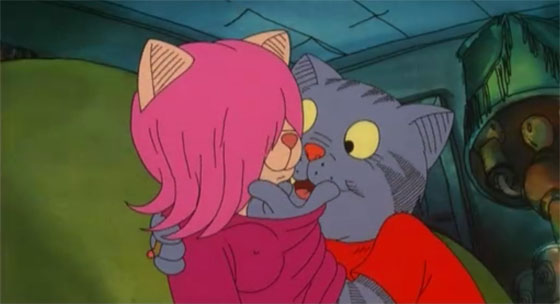 What’s especially peculiar is that it overtly imitates Bakshi’s style, which is something you don’t see very often, since R-rated animated films are so rare on these shores. From the semi-improvisational dialogue, to the mix of animation with live action stock footage, to the gritty street milieu, the film looks and feels like a Bakshi film…kinda. It lacks the soul he brings to his pictures.
 Fritz is a complete wreck here. The premise seems to be that the 60’s counterculture has crashed and burned as the new decade dawns. He’s married with kids. His dreams have died, and the picture ends not much further from where it began – Fritz is thrown out of the house, and he’s just as dazed, with a glassy stare. Credit to the film, I suppose, that it successfully captures that dreary, burned-out feeling, but it might just be that the filmmakers had run dry on imagination. And imagination is the last thing an animated film should lack.