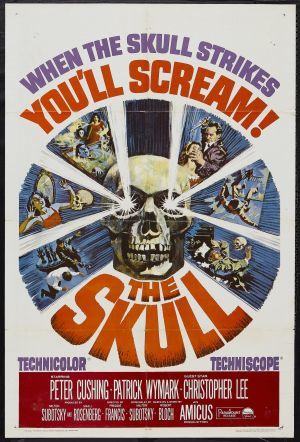
DVD Drive-In has announced that Legend Films will be releasing a double-feature Blu-Ray upgrade of two of the titles they released a couple years back on DVD: The Man Who Could Cheat Death (1959), an early Hammer horror of the Dorian Gray variety, and The Skull (1965), a Peter Cushing/Christopher Lee team-up from rival horror studio Amicus. The former is more of interest to see how 50’s Hammer can look in high definition; the story itself is rather dull by Hammer’s standards, though I’m anxious to give it a second look (it does have a fine pedigree, directed by Terence Fisher and co-starring Hazel Court and Christopher Lee). The Skull, on the other hand, is sorely underrated, a dream-like thriller with overtones of H.P. Lovecraft, and a stellar occult auction scene in which the two Hammer stars square off. The Blu-Ray double feature is due for release on May 3rd, and you can pre-order from Amazon at the link below.
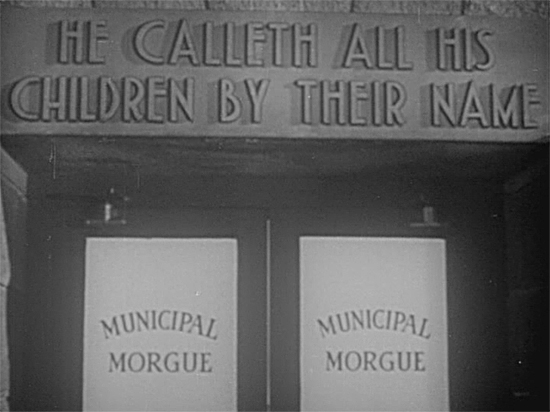
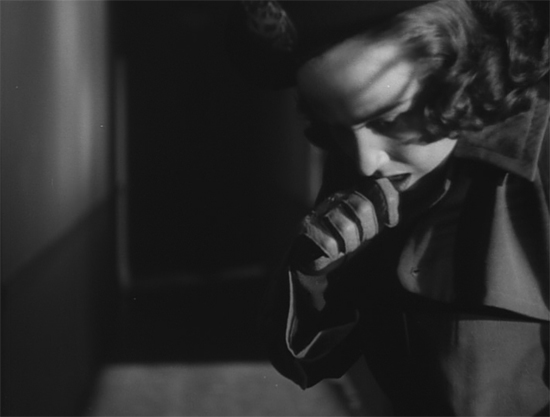
This is my favorite of the Val Lewton-produced films, a very curious mixture of horror and film noir that fans of either genre should embrace with equal zeal. Mark Robson was not as naturally gifted a director as Jacques Tourneur, and he even steals from Tourneur’s Cat People (1942) for a scene late in this film (a Lewton trademark: a girl walking alone down a shadowy street)–but even Tourneur stole from Cat People, and it cannot be denied that The Seventh Victim is so strange that ultimately it’s a complete original. In fact, it’s a wonder that the film ever got made.
The plot, on the face of it, is a very simple mystery. Mary (Kim Hunter of A Matter of Life and Death) ventures forth from the Catholic school she attends to find her older, sophisticated and worldly sister Jacqueline (Jean Brooks, with a Bettie Page haircut and a sultry pout). Jacqueline’s gone missing, but it seems that everyone is after her, including her husband Gregory Ward (Leave it to Beaver’s Ward Cleaver, Hugh Beaumont) and some menacing types who urge a detective hired by Mary to mind his own business. More characters than are absolutely necessary are added to the mix: Dr. Judd (Lewton mainstay Tom Conway), who claims to be Jacqueline’s new lover; Jason Hoag (Erford Gage), a poet and acquaintance of Judd’s who tries to help Mary out; the proprietors of a cafe called, significantly, The Dante; the terse Miss Redi (Mary Newton), owner of a perfume business of which Jacqueline was once co-owner; and a mysterious, exclusive society to which Jacqueline belongs. It is revealed, after a fairly long wait, that this society worships the Devil. Jacqueline betrayed their trust, and now they want her to die.
On certain matters–those not related to a major theme which I’ll get to in a moment–the film feels just slightly undercooked, and one suspects that either significant scenes of exposition were cut, or the script was rushed too hurriedly into production. The presence of many male characters suggests an attempt to develop a love triangle a la Cat People or I Walked with a Zombie (1943); but little time is spent developing the relationships, and more often we’re told who is in love with whom rather than feeling it. And why does Dr. Judd know telepathy (used in only one scene)? And who is that mysterious woman next door who claims to be dying? And isn’t it odd that the secret society claims to worship the Devil, yet we see them do nothing of the sort? (I assume the Hays Code has something to do with that last point.) It might take multiple viewings to see how seemingly random elements connect. For example, late in the film Dr. Judd tells Jason, “That girl you loved, that other patient of mine. She didn’t disappear. She’s in an asylum, a horrible, raving thing.” It’s very easy to forget that much, much earlier in the film, a brief exchange between these two revealed that this was their connection: Jason loved one of his patients. That this character arc should be introduced and concluded in two curt dialogue scenes strikes me as bizarre. They could just as easily have been discarded altogether, except that Dr. Judd’s last words on the subject are so callous and so invaluably haunting.
All of Lewton’s films seem to toss their characters into a whirlpool. They’re swimming around an abyss that’s about to swallow them, and it’s this existential despair, so unfaked, that sets his string of horror films apart from your Universals and your Hammers and your giallos. The Seventh Victim has its weaknesses, including the strangely underdeveloped script, but those weaknesses are also its strengths. The random, isolated scenes become like moments in a fever dream. Subsequently, The Seventh Victim, of all the Lewtons, feels the most unhinged. It’s “a horrible, raving thing.” That Mary leaves a holy place to find her sister, and almost immediately heads for a cafe called The Dante, explicitly outlines that she is on a journey into the Inferno. (In the cafe she finds the poet Jason lurking below a painting of another poet, Dante Alighieri–right under his feet.) The proprietors of The Dante rented a room to Jacqueline, Room Number Seven, and it’s here that Mary sees the most horrifying image in the film: there is nothing in the room but a stool and a noose hanging above it. Later, Gregory Ward explains that Jacqueline rented the room without the intention of using it. She wanted to know that she could die, that it was an option she was not choosing. He seems to find it harmless. But a glance at Dante’s Inferno reveals that those who commit suicide, a mortal sin, are destined for the Seventh Circle, where they are transformed into thorny trees and torn at by Harpies. Here, then, is The Seventh Victim’s true subject: suicide. Jacqueline, hounded by the devil-worshippers, feels that she has nowhere to run. In her panic, she kills the detective hired by Mary when he discovers her hiding place. This is one of the film’s most memorable scenes, as Mary and the detective gaze down a pitch-black hallway, the Abyss Itself. Mary cannot bring herself to walk down it, even if her sister is lurking at the other end, so she urges the detective to go alone. He emerges from the darkness a moment later, staggering, before collapsing dead.
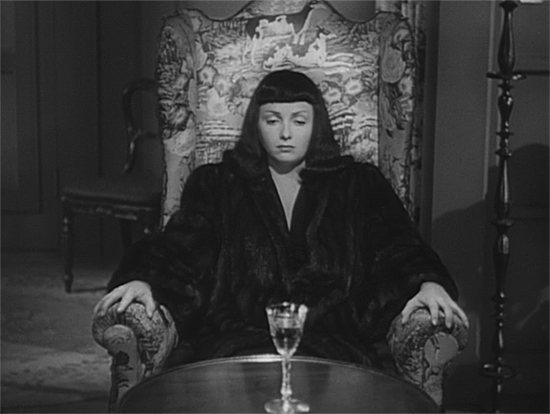
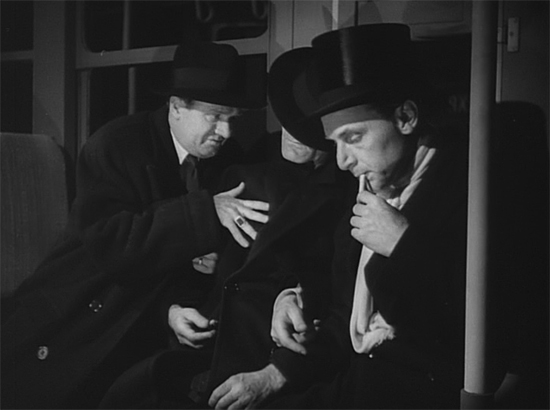
Significantly, the film opens and closes with a quote by John Donne, first glimpsed written upon a stained-glass window: “I run to death, and death meets me as fast, and all my pleasures are like yesterday.” Just as Mary directly confronts death in that black hallway, and sends the detective as her surrogate to meet it, death pursues her: a few moments later she is riding a train through the city, and sees two men pretending to hold up a drunken third–but as she stares, she realizes it’s the detective, and the two men are moving the body so they can dispose of it. Yet the dance with death is primarily Jacqueline’s: when she is finally brought back into the posh sanctuary of the cult, they urge her to drink a cup of poison placed before her. This has been their voted-upon compromise: their society has a strict rule against violence, yet, in a seeming contradiction, any who defy them must die. Now if only Jacqueline would drink the poison, it would be suicide, not murder. Jacqueline, her hands extended upon the arms of the chair and tapping one finger anxiously, says “No, no, no,” like a child refusing to eat her vegetables. Nevertheless, she doesn’t run, panic, or scream. As we’ve been told, as the film has driven home determinedly, she has a longing for death. This longing, and her weak resistance to it, is the central conflict of the film. Only hours later, when her young friend breaks down in tears and begs her to drink does Jacqueline finally relent and pick up the cup, placing it to her lips, before that same friend knocks it out of her hand–she doesn’t want to be the one responsible for her friend’s death. Jacqueline is sent away, and told by the leader of the group that there will be another vote, and this time there might be violence. She leaves the tenement building and begins to walk down those familiar Val Lewton nighttime streets, waiting for a murderer to appear–and so he does, as though she had wished him into existence, and there follows a deadly chase.
What makes The Seventh Victim so shattering are its last scenes. Jacqueline fatalistically approaches Apartment #7. Another woman emerges from Apartment #8 in a bathrobe. She says, “I’m Mimi. I’m dying. I’ve been quiet, oh ever so quiet. I hardly move. And yet it keeps coming all the time, closer and closer. And I rest and I rest, and still I’m dying.”
JACQUELINE: And you don’t want to die. I’ve always wanted to die. Always.
MIMI: I’m afraid, and I’m tired of being afraid–of waiting.
JACQUELINE: Why wait?
MIMI: I’m not going to wait! I’m going out. I’m going to laugh and dance, and do all the things I used to do.
JACQUELINE: And then?
MIMI: I don’t know. (She goes back into her apartment.)
JACQUELINE: You will die.
In a way, this mirrors a minor moment earlier in the film when Jason is asked by The Dante’s proprietor to go and cheer up Mary and Gregory, to tell them jokes and make them happy. As soon as he arrives at their table, he apologizes that their very presence and demeanor has made him sad again. There seems to be no escape from despair. In the very last moment of the film, we see Mimi a second time, emerging from #8 dressed in her finest, ready to have a good time and to cast aside her worries. As she passes the closed door of #7, we hear the thumping sound of a stool toppling against the floor.
[This essay originally appeared in 2009 at my website jeffkuykendall.com.]
You can purchase the Val Lewton Collection from Amazon at the link below.
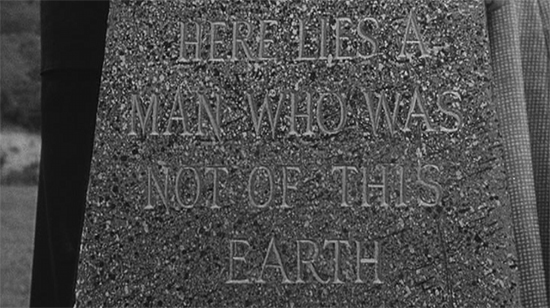
The plot of Roger Corman’s Not of This Earth (1957) is simple and efficient B-movie fare: a space vampire named Mr. Johnson (Paul Birch) is killing off Earthlings and draining them of blood with a device he carries in his silver suitcase. But the screenplay, by Charles B. Griffith (The Little Shop of Horrors) and Mark Hanna (Attack of the 50 Foot Woman), layers on the quirks, and coupled with an engaging lead performance by Beverly Garland (It Conquered the World), it makes for a memorable 50’s sci-fi cult picture. Released as the supporting feature of Corman’s utterly goofy Attack of the Crab Monsters, it outclassed the self-imposed competition and has earned (to date) two revisits, one in 1988 and another in 1997. The 1988 film, directed by Jim Wynorski (Chopping Mall), is such a close remake that it becomes a parody, and is best appreciated by those familiar with the original. So…double feature:
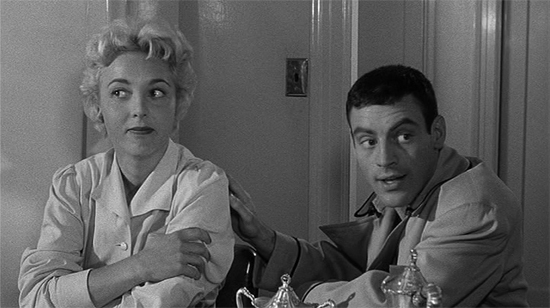
Garland is the chief reason to watch the original, attractive and radiating wit, making the best of every line. She plays Nurse Nadine, hired by Mr. Johnson to assist him with his blood transfusions, since he needs a constant supply. Meanwhile, in secret, Mr. Johnson operates a boxy remote control device to open an inter-dimensional portal in his closet, so he can confer with home planet Davanna. His master gives him strict instructions: continue acquiring large quantities of blood to ship back home; receive blood transfusions to confirm that human blood is compatible with Davannan; and once this is known, lay the path for Earth’s subjugation. But his chauffeur, the gun-toting ex-crook Jeremy (Jonathan Haze), begins to suspect that there’s something not quite right with his boss. For one thing, he never removes his sunglasses. He speaks in a monotone. Visitors to the house are never seen leaving. Jeremy also discovers the suitcase with the blood-draining equipment, and a flask with something strange living inside. So when he’s not feverishly hitting on Nadine, he talks of the strange goings-on; and soon enough they begin to trade information, and investigate just what their employer is really up to.
Not of This Earth was shot in just twelve days, in typical Corman budget-crunching fashion. One take, make sure it’s in focus, set up the next shot. Attack of the Crab Monsters was more visually ambitious: it had giant beasts lurking in caves, with the heroes lobbing dynamite at them; NOTE‘s monster turns out to be a cheap-looking umbrella alien that’s guided by a wire, so it should be no wonder that Crab Monsters received the top of the bill. But Griffith and Hanna perform alchemy out of Corman’s limited means (Griffith tends to get the most credit, given the reliably clever scripts he produced for the Corman factory). The film is barely more than an hour, but it’s one you’re more inclined to remember; it’s got almost everything you want in this kind of picture.
When Wynorski decided to remake it for Corman’s New World Pictures in 1988, he made a bet with the King of the B’s that he could film it within the same limited period as the original – and he won, completing shooting in eleven-and-a-half days, besting Corman’s twelve. He accomplished this by using limited (sometimes transparently fake) sets, and padding his running time by cannibalizing footage from some other New World Pictures, like Humanoids from the Deep (1980), Hollywood Boulevard (1976), and Galaxy of Terror (1981). (This practice was pretty common at New World: the spaceship from 1980’s Battle Beyond the Stars, for example, flies from one Corman movie to the next.) Wynorski’s film is largely remembered today because it was the first non-pornographic film to star Traci Lords, and the last in which she appeared unclothed. To date, she’s one of the few adult film stars to transition successfully to a mainstream acting career, having appeared in John Waters’ Cry-Baby (1990), the first Blade movie (1998), and countless other TV shows and genre movies. Here, her line readings are still a bit rough, with only a few moments in which she manages to shine; but blame it on the shoot, since it’s unlikely that Wynorski gave the acting novice much of a chance to redo any takes.
The 1988 version is chiefly enjoyable because Wynorski apparently made it with the original’s script in hand. At times, it is a shot-for-shot, line-for-line remake, so that it faithfully honors the spirit of 50’s B-movies while escalating every moment into camp. It doesn’t matter to Wynorski that the dialogue is hopelessly dated. As with Robert K. Weiss’ film-within-a-film segment of Amazon Women on the Moon (1987), which copies Fire Maidens from Outer Space (1956), there’s a lot of affectionate nostalgia when sending up the absurdities of the original. But he also updates certain elements to match his own (often lewd) sensibilities. In a head-to-head matchup, which film comes out on top?
Doomed Teenager Make-Out Session
Both films begin with two random teenagers on a date, stalked by the deadly alien. In the original, the girl exits the car, walks a distance, and is confronted by Paul Birch and his suitcase. He removes his glasses and she screams. But Wynorski recognizes what teenage make-out sessions in movies are for: exploitation. So we get the requisite nudity, followed by the alien murdering not one, but both of them. We’re even treated to his glowing eyes, which Corman withholds for a while in his version. Winner, though not for subtlety: 1988.
Opening Credits
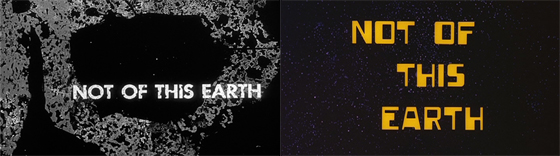
Corman presents a collection of almost abstract but decidedly sinister and skull-like floating images accompanied by an equally eerie score. Wynorski just shows gory scenes from other New World movies. Winner by a large margin: 1957.
Mr. Johnson
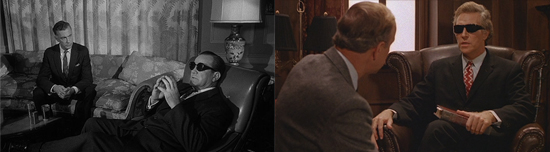
Paul Birch looks like he’s suffered severe whiplash, and his monotone often borders on the unintentionally funny. Nevertheless, as good as Arthur Roberts is in the role, he’s clearly doing an impression of Birch; and imitation is the sincerest form of flattery. Winner due to iconic reasons: 1957.
Davanna Conferences
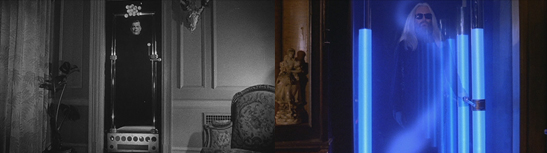
Mr. Johnson communicates with his leader via a transmitter/teleporter in the lounge closet. In the original, it’s a floating head. Wynorski, perhaps a ZZ Top fan, uses a bearded man with sunglasses and Jesus hair. Winner: 1957, mainly because I don’t know what’s going on with 1988 here.
Nadine Does Sexy Things Behind a Screen
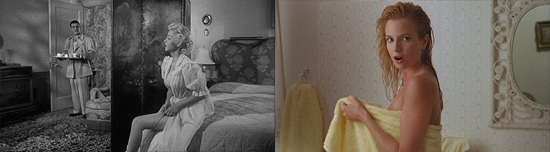
Jeremy delivers breakfast to Nadine in her bedroom, and she addresses him while (falsely) believing she’s unobserved behind a screen. In a very daring moment for a 50’s film, Beverly Garland sensually massages a bare leg and then slips on some pantyhose. But in 1988, this wasn’t quite enough. Traci Lords, mouthing the same repartee, dries her naked body off with a towel. Winner: I’m sorry, Beverly. There’s nothing to be done. 1988.
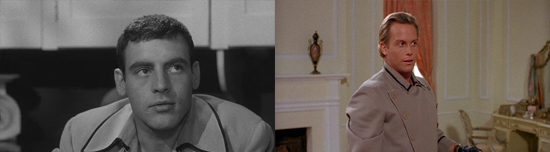
Jeremy
Jonathan Haze plays Jeremy as a likeable young dope, but in each scene with Garland he’s so out-acted that he comes across as barely worth her time. Lenny Juliano, on the other hand, honors Haze’s characterization but plays up the lovable scamp. He seems to have his finger on the tone Wynorski is going for with his remake: cheesy but endearing. He also makes a good foil for Lords, especially when they engage in a poolside flirtation/duel. When Haze’s Jeremy dies, it’s no big loss, but Juliano is such a presence that his death seems not just premature, but downright unfair. Winner: 1988.
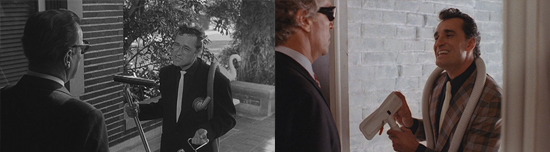
Death of a Vacuum Cleaner Salesman
Corman regular Dick Miller saves the Earth from an alien saboteur in War of the Satellites (1958), but as a vacuum salesman, he’s no match for the vampire from Davanna. Miller improvised most of his dialogue, using a pitch he once actually performed door-to-door. The brief cameo is so indelible that Wynorski used a Miller lookalike (although he could have just used Miller again, unless Joe Dante was taking up all of the actor’s time). But he can’t quite recreate Miller’s death scene, in which the actor has the guts to deliver an over-the-top double-take directly to the camera. Winner: 1957…and bravo, sir.
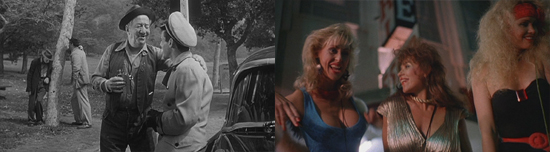
Mr. Johnson’s Buffet
Desperate for large quantities of blood to deliver back to Davanna, Mr. Johnson is escorted by Jeremy around town, until he encounters three drunken hobos at a park, who will fit his purposes just fine. Wynorski, dissatisfied that hobos don’t have large breasts, makes it three squeaky-voiced hookers instead. Winner: 1957, because the hookers are pretty irritating.
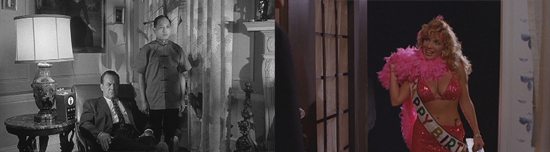
The Live Specimen
Required to deliver a live specimen to the Davannans, Mr. Johnson turns up a Chinese fellow out of the blue. Wynorski would rather it be a strippergram. Winner: 1957, for its sheer inexplicability.
Police Officer Harry
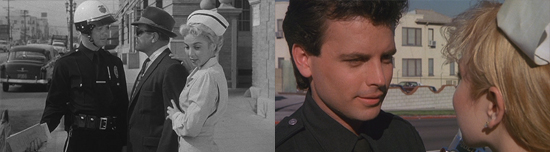
Nadine’s boyfriend is a cop, and both films make the mistake of thinking such a bland character should survive to the end of the film instead of the infinitely more entertaining Jeremy. Winner: 1957, but only because 1988’s Roger Lodge was later the host of Blind Date. I hold it against him.
Nadine
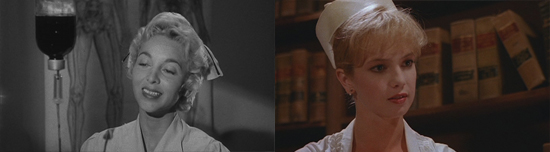
Traci Lords looks great in every outfit she wears in this film (well, except for that bizarre, Muppet-like frizzy thing), and also in every outfit she doesn’t wear. But Beverly Garland is sassy, intelligent, and a worthy opponent to a telepathic space vampire. She’s not hard on the eyes, either. Winner: 1957.
So it’s the original by 8-3. Wynorski might have won his bet with Corman, but ultimately, it’s Corman’s picture you’ll want to revisit. It’s why they invented the 1950’s.
Both films are currently available on DVD from Shout! Factory as part of their great Roger Corman Cult Classics line:


 This is my favorite of the Val Lewton-produced films, a very curious mixture of horror and film noir that fans of either genre should embrace with equal zeal. Mark Robson was not as naturally gifted a director as Jacques Tourneur, and he even steals from Tourneur’s Cat People (1942) for a scene late in this film (a Lewton trademark: a girl walking alone down a shadowy street)–but even Tourneur stole from Cat People, and it cannot be denied that The Seventh Victim is so strange that ultimately it’s a complete original. In fact, it’s a wonder that the film ever got made.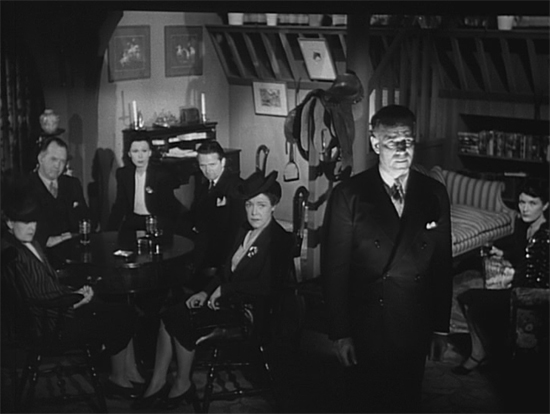


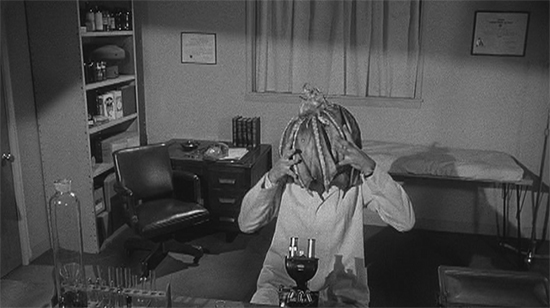
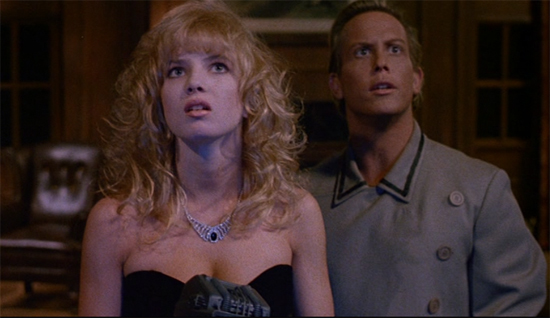 When Wynorski decided to remake it for Corman’s New World Pictures in 1988, he made a bet with the King of the B’s that he could film it within the same limited period as the original – and he won, completing shooting in eleven-and-a-half days, besting Corman’s twelve. He accomplished this by using limited (sometimes transparently fake) sets, and padding his running time by cannibalizing footage from some other New World Pictures, like Humanoids from the Deep (1980), Hollywood Boulevard (1976), and Galaxy of Terror (1981). (This practice was pretty common at New World: the spaceship from 1980’s Battle Beyond the Stars, for example, flies from one Corman movie to the next.) Wynorski’s film is largely remembered today because it was the first non-pornographic film to star Traci Lords, and the last in which she appeared unclothed. To date, she’s one of the few adult film stars to transition successfully to a mainstream acting career, having appeared in John Waters’ Cry-Baby (1990), the first Blade movie (1998), and countless other TV shows and genre movies. Here, her line readings are still a bit rough, with only a few moments in which she manages to shine; but blame it on the shoot, since it’s unlikely that Wynorski gave the acting novice much of a chance to redo any takes.
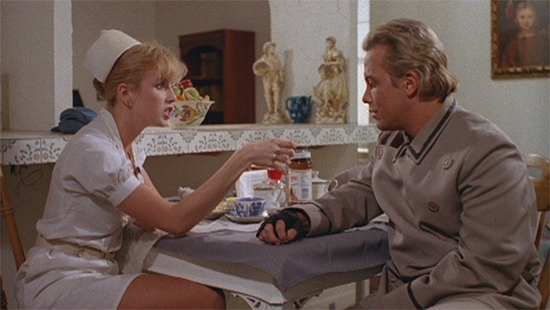 The 1988 version is chiefly enjoyable because Wynorski apparently made it with the original’s script in hand. At times, it is a shot-for-shot, line-for-line remake, so that it faithfully honors the spirit of 50’s B-movies while escalating every moment into camp. It doesn’t matter to Wynorski that the dialogue is hopelessly dated. As with Robert K. Weiss’ film-within-a-film segment of Amazon Women on the Moon (1987), which copies Fire Maidens from Outer Space (1956), there’s a lot of affectionate nostalgia when sending up the absurdities of the original. But he also updates certain elements to match his own (often lewd) sensibilities. In a head-to-head matchup, which film comes out on top?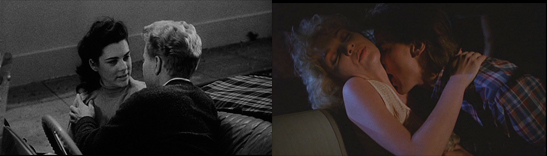
 Mr. Johnson
 Davanna Conferences
 Nadine Does Sexy Things Behind a Screen
 Jeremy
 Death of a Vacuum Cleaner Salesman
 Mr. Johnson’s Buffet
 The Live Specimen
 Police Officer Harry
 Nadine