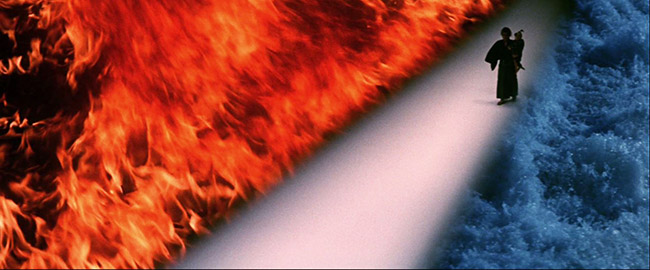
Very late in the second film of the Lone Wolf and Cub series, in the middle of a desolate desert, one of the deadliest hired assassins in the world has his throat cut by the former Shogunate Executioner, Itto Ogami (Tomisaburo Wakayama), in a climactic duel. Rather than the usual geyser of blood to which we’ve become accustomed, the skin simply parts at the diagonal wound. Then a cloud of scarlet like blowing sand wafts against the blue sky, and wind whistles low into the soundtrack. The camera pans to the right, and we see that the red mist is billowing from the doomed man’s neck. “The cut wails like a cold winter wind,” he says. “They call it mogari-bue, ‘the whistle of a fallen tiger.’ I’ve always wished to kill someone, just once, and create such a fine cut as to sing this tune. Now I’m hearing it from my own neck.” This is the world of Lone Wolf and Cub: violent and subdued, sometimes in turn, sometimes all at once, achieving a pulp poetry. The series was based on the long-running manga from Kazuo Koike, brought to the screen from producer Shintaro Katsu (Zatoichi the Blind Swordsman himself), and starring Katsu’s pudgy-cheeked older brother, Wakayama. The “cub” of the title is the infant son of Wakayama’s samurai-on-the-run, Itto Ogami, a Suio-ryo master swordsman. In flashbacks in the first film in the series, Lone Wolf and Cub: Sword of Vengeance (1972), we learn that Ogami’s wife and servants were slaughtered by the rival Yagyu clan, with Ogami framed for the crime in the eyes of the shogun. Rather than commit suicide via seppuku, Ogami flees with his tiny son Daigoro (Akihiro Tomikawa), escaping an army of the Yagyu warriors through a loophole: he wears a robe with the sacred Hollyhock Crest, which the Yagyu cannot honorably slice to shreds. Ogami then walks the demon road of meifumado, lowering himself to become a hired assassin. Because he always pushes his baby cart, with Daigoro stowed inside, he becomes known as “Lone Wolf and Cub.” He also learns to hide his weapons inside the baby cart, and even teach Daigoro a lethal trick or two.
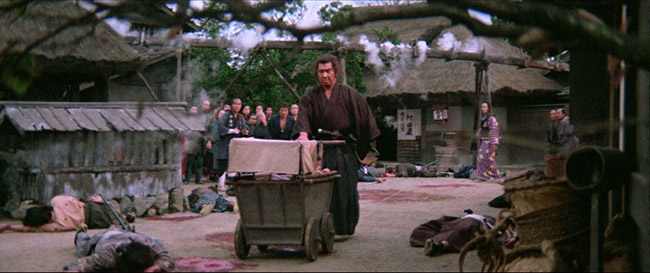
In “Lone Wolf and Cub: Sword of Vengeance,” Itto Ogami (Tomisaburo Wakayama) pushes his baby cart down a road of bloody death.
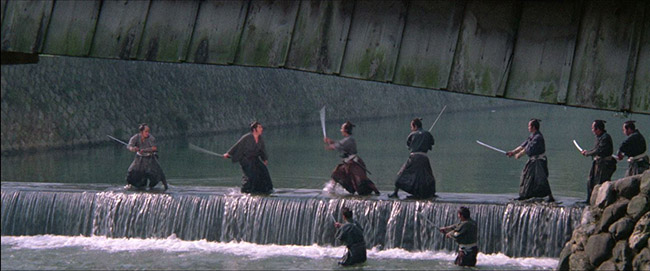
Sword of Vengeance quickly establishes the series’ motif of child endangerment with a ruthless sequence in which Ogami, acting as the Shogunate Executioner, steps in to execute a lord for political purposes; it just so happens that the lord is a very small child. Ogami fulfills his duty without a flicker of doubt on his grim features, because he is loyal to the Tokugawa shogun. Later, when his loyalty has proven worthless due to the machinations of the Yagyu clan led by Retsudo Yagyu (Yunosuke Ito), he asks his infant son Daigoro to choose whether he will follow his father (on the demon’s road) or his mother (into death), placing before the child a ball and a samurai sword. If the unknowing boy crawls toward the ball, Ogami will kill him. Instead, Daigoro crawls toward the blade. Ogami begins to weep: it would have been better for Daigoro, he is certain, if he’d chosen to be reunited with his mother. Ogami’s past is revealed in phases throughout the first half of Sword of Vengeance, and in an eerie touch, most of the soundtrack has been sliced away, leaving only the spare dialogue and the occasional clashing of swords. The roaring waters of the canal where Ogami fights his wife’s killers, for example, are completely silent. When we return to the present, in a downbeat Rashomon-style downpour, the soundtrack floods with the noise, and we subconsciously realize we have been returned to the present. Director Kenji Misumi (The Tale of Zatoichi) uses every trick in the playbook, making this manga as cinematic as possible. A sex scene is abstracted into overlapping layers of sensual images of caressed flesh. A prolonged flashback is triggered by children playing with a ball in a street, and when the flashback reaches its climax in a suspenseful Western-style showdown in a grassy field (borrowed, NES fans, for a cut scene in the first Ninja Gaiden), the key player in that showdown – a sun blazing into the eyes of the swordsmen – melts into the bouncing ball and the crude sing-song of the children in the present day. Much of the film is seen through the eyes of a child, the “Cub.” After a particularly brutal climax, Misumi lyrically cuts between images of monkeys playing in the street to Daigoro’s delighted face, and then to the cart and the blood-stained Ogami pushing it onward. The violence is extreme and stylized, with limbs dropping to the ground and geysers of red dye rocketing out of sockets and neck stumps. But Misumi finds ways to stage the carnage which are still revelatory. In the climax, as Ogami slashes at a crowd of armed thugs and rapists, one man is cornered into an alley, and is pushed half out of the frame before we happen to notice his head come tumbling loose in the opposite direction. By avoiding centering the image or making a showcase of it, the impact is somehow greater. Misumi is completely in charge of the mayhem.
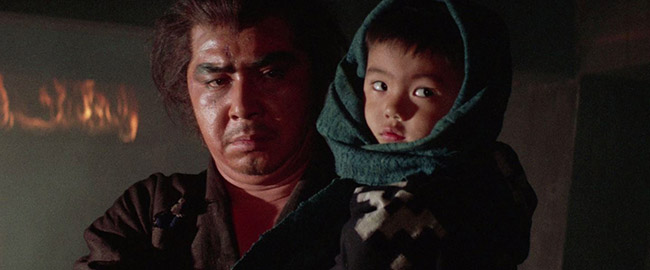
At one point in “Lone Wolf and Cub: Baby Cart at the River Styx,” the assassin and his son Daigoro (Akihiro Tomikawa) find themselves trapped in the hold of a burning ship.
The second installment, Lone Wolf and Cub: Baby Cart at the River Styx (1972), released just a few months after the first, doubles down on the action and adds an epic scope (while keeping within an efficient B-movie running time of 81 minutes). Lone Wolf and Cub are still being hunted, this time by an assortment of ninja and an order of female assassins, the Akashi-Yagyu sword-mistresses, with the fierce Sayaka (Kayo Matsuo) in charge. While they plot – and Sayaka demonstrates the abilities of her women by chopping a ninja warrior into pieces like the black knight scene from Monty Python and the Holy Grail – Ogami is hired to kill a spy who is stealing a clan’s wealthy secret of producing indigo dye. The spy, unfortunately, is being escorted to Edo over land and sea by three notorious killers, the Hidari Brothers (Minoru Oki, Shin Kishida, and Shogen Nitta), each identified by the weapon he wields: a piercing claw, iron fists, and a club. Kazuo Koike’s pulp story provides returning director Misumi the opportunity to go full Sergio Leone, albeit in the sword-fighting chanbara mode. The climax of this film takes place in the desert, and there’s a majesty as well as a dose of Leone cool as the Hidari Brothers march up a dune to face the silhouette of Ogami. The imagery in the desert scenes is also reminiscent of El Topo, not just with the crucial role played by the warrior’s son, but also in the tendency toward surrealism: the Hidari Brothers are able to detect ninja hidden beneath the dunes, and stab downward, as blood slowly oozes through the grains of sand. There’s a healthy dose of surrealism, too, in earlier scenes, notably when the sword-mistresses, disguised as women bringing radishes back from the field, fling those radishes at Lone Wolf and Cub, and we see them getting stuck in the cart (there are knives hidden inside them). After he slays them, he continues to push the cart forward, one radish still jutting from the front. And when Ogami proves his talents to the men who hire him, he hurls his sword, tearing through one wall and planting into a second wall, before blood spurts down the blade, and an invisible weight drags the sword down to the ground: a hiding assassin, ferreted out by Ogami’s almost supernatural instincts.
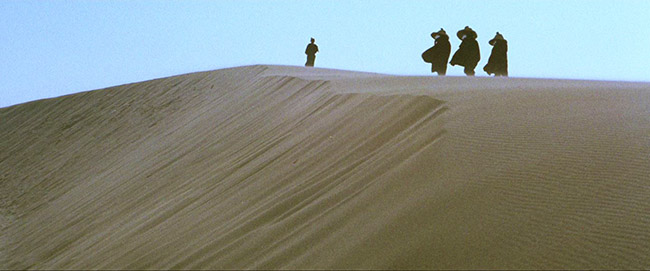
The Hidari Brothers prepare to face Itto Ogami.
The appeal of the Lone Wolf and Cub films is not just the surface pleasures, which, believe me, are multitude: the lush imagery, the breathtaking scenes of slaughter, the black comedy and the outré, grindhouse-ready strokes of pulpy imagination. At the center is the story of a widower father and his small son. Always moving, always looking for income or food (in the first film, Daigoro suckles from the first breast that’s offered, even though it’s from a madwoman who mistakes him for her child), Lone Wolf and Cub offer a unique familial twist on the samurai fable. As the ultimate warrior father, Wakayama is a deadpan wonder, expressing himself solely through a movement in his eyes or a slow reach for the handle of his sword. He’s inscrutable. In the first film, he unexpectedly agrees to the proposal of bandits to have sex with a woman under their lustful gaze, but it’s only to save her own life. In Baby Cart at the River Styx, Misumi lets the audience believe for an excruciatingly long minute that Ogami might actually rape the female killer who’s been stalking him, until it’s revealed that he’s only stripping her down so the three of them – two killers and a small boy – can huddle together to stop from freezing to death. Wakayama’s less-is-more performance, in the samurai film mold, is ideally suited for screenwriter/manga author Koike’s visual sense of storytelling, where long silences and the measured distance between Ogami’s hand and his sword – or, more handily, his baby cart – become all you need to know. All six Lone Wolf and Cub films are now available on Blu-Ray from the Criterion Collection.
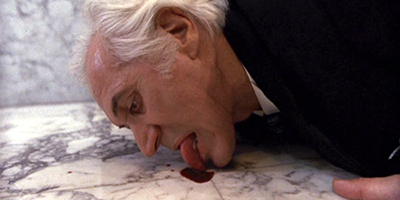 Though Christopher Lee’s Count Dracula didn’t return for Hammer’s first Dracula sequel, Brides of Dracula (1960), Peter Cushing’s Van Helsing did, and the film stands as one of Hammer’s best vampire films. (It’s now available on Blu-Ray as part of Universal’s Hammer Horror 8-Film Collection box set.) Tom Holland’s
 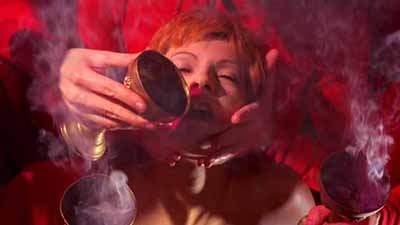 Dennis Wheatley’s series of black magic-themed thrillers featured the Duke de Richleau, a Van Helsing-style occult expert, portrayed perfectly on-screen by Christopher Lee in the top-tier Hammer outing
 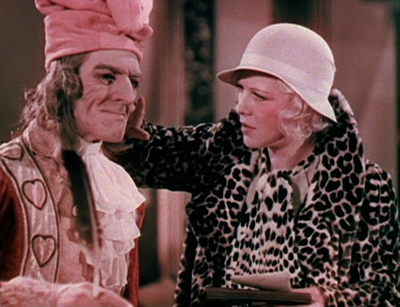 If you have the opportunity to watch Vincent Price’s House of Wax (1953) in 3-D, do. Otherwise you’ll be stuck with a scene where a man flings a yo-yo at the camera for a long minute without any particular urge to duck. The film helped kick-start Price’s second career as a horror star, and it’s a full-color, full-hammy, full-fun 3-D spectacular. But dig back earlier and you’ll discover a gem: Mystery of the Wax Museum (1933). Along with its cinematic twin brother Doctor X (1932), the film was made using an early two-color Technicolor process, was directed by Casablanca‘s Michael Curtiz, and features Lionel Atwill and the first scream queen, Fay Wray. The wax museum and its historical and ghoulish figures are creepy, but the film is also funny, with a wonderful performance by Glenda Farrell (Little Caesar) as the kind of fast-talking, effortlessly witty investigative reporter that only the screwball 30’s could produce. Available (along with Doctor X and others) in Warner’s Hollywood’s Legends of Horror box set.
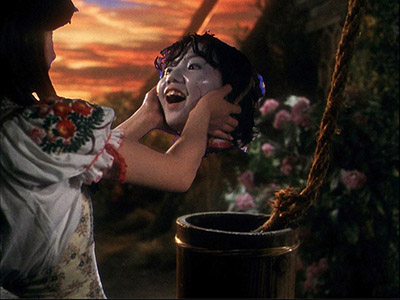 The haunted house tale is my favorite subgenre, and perennial favorites include The Innocents (1961), The Haunting (1963), and
 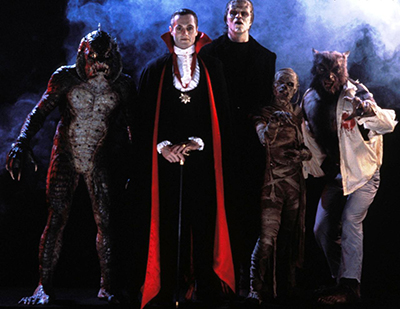 Famously, toward the end of the Universal Studios monster cycle, they began to mix and match their monsters in films like Frankenstein Meets the Wolf Man (1943) and House of Frankenstein (1944) – essentially establishing a shared universe decades before Marvel. Perhaps the most entertaining of these is Abbott and Costello Meet Frankenstein (1948), even if it spelled the ending of taking the monsters seriously. In the film, the comedy duo meet Dracula (Bela Lugosi, in a rare reprise of the Count), the Wolf Man (Lon Chaney Jr., in his best-loved role), Frankenstein’s Monster (Glenn Strange), and even The Invisible Man (Vincent Price, in a voice-only cameo). The Bowery Boys Meet the Monsters (1954) was a less classy, but nonetheless amusing monster mash, one of an endless series of Bowery Boys movies. Decades later, screenwriter Shane Black (Lethal Weapon) and director Fred Dekker (Night of the Creeps) shopped a script nostalgically reuniting the Universal Monsters, but when Universal turned it down, they went with more generalized treatments of such characters as Dracula, Frankenstein’s Monster, a Mummy, a Wolf Man, and even a Gill Man (most certainly not the Creature from the Black Lagoon). The Monster Squad (1987) was essentially “The Goonies meet the Monsters.”
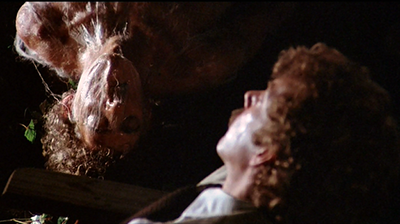 Philip Kaufman’s
 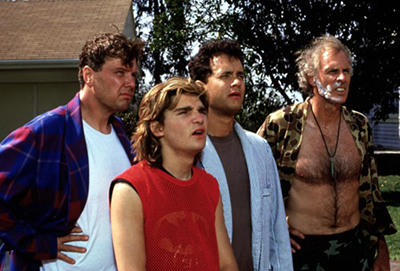 If you’ve watched The Texas Chain Saw Massacre (1974) too many times, now might be a good time to revisit its oddball sequel, The Texas Chainsaw Massacre II (1986). Tobe Hooper took the film as a contractual obligation, but used the opportunity to both send up the original film and take it in new, stranger directions. For a more family friendly option, spend some time with Joe Dante’s cult classic horror comedy
 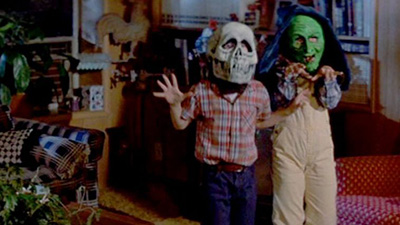 Once maligned, now considered a seasonal favorite, Halloween III: Season of the Witch (1982) relegates Michael Myers to a cameo (Halloween is playing on a TV), and instead boldly suggests that the franchise should become an anthology series. That didn’t take thanks to unenthusiastic audiences, which leaves this film an anomaly: using a story by John Carpenter and
 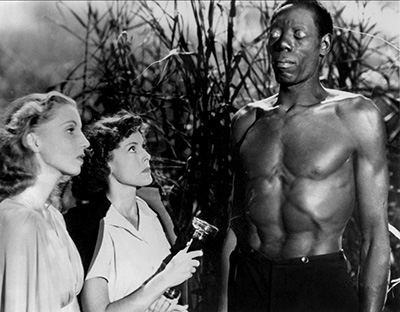 Look, flesh-eating zombies all came from Romero, right? And now we can’t have anything else, apparently. But if you’re looking for a return to old-school, voodoo-conjured zombies, you can’t go wrong with the Bela Lugosi classic White Zombie (1932), the eerie Hammer horror
 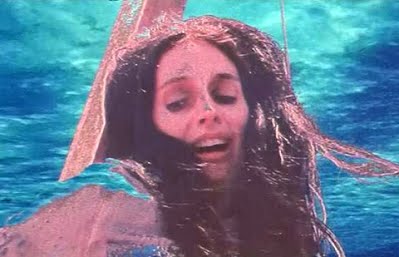 Jean Rollin’s debut feature film, the black-and-white, improv-jazz-scored